I was explaining modular to a co-worker. I said that modular synths can be set up for a wide variety of things, not just techno or EDM, and that someone could design a rack to be whatever they wanted. I then rattled off some examples: maybe a super complex drum machine, a wild effects unit for a guitar, or to use pinball physics to simulate a radioactive cat factory.

That made them spew their coffee all over the place, so of course I had to take a shot at it:
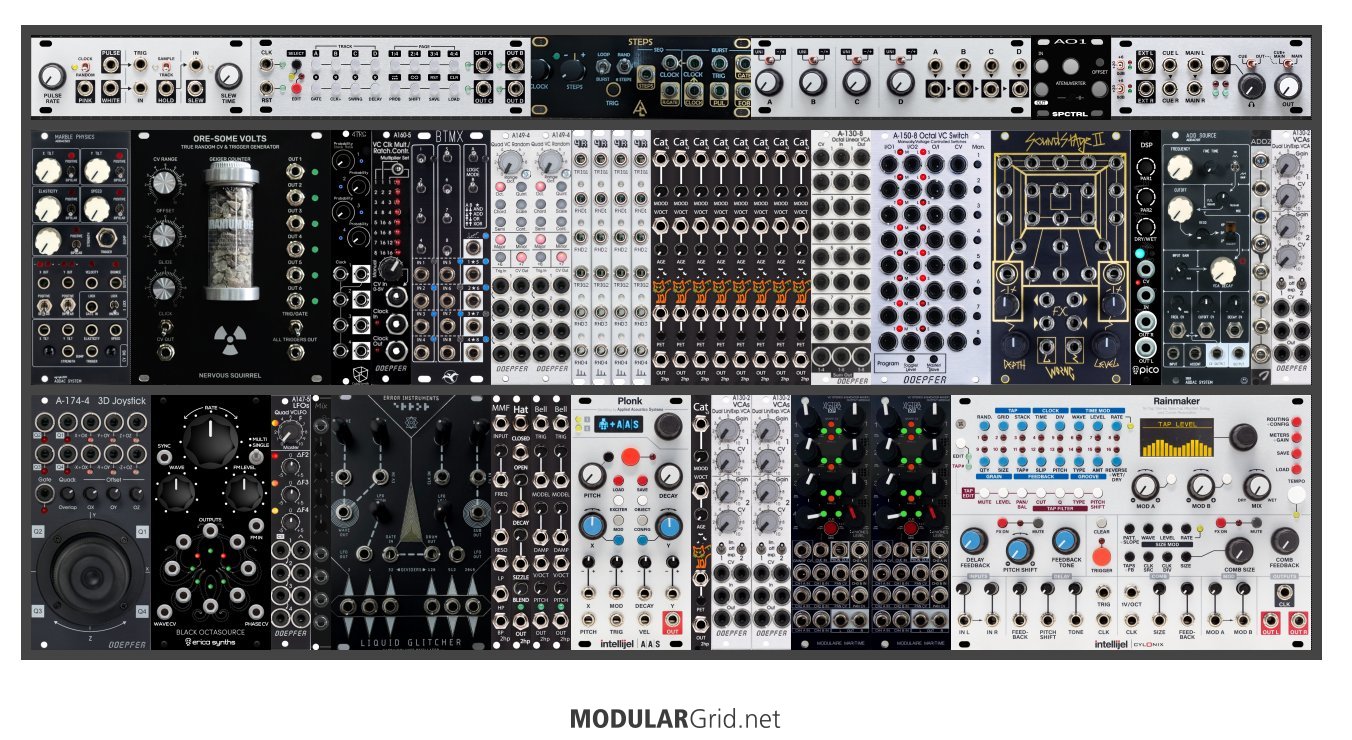
It starts out simple: ADDAC107 Acid Source for a bassline & Liquid Glitcher for some background machine sounds.
Rhythm: Steppy, Steps, A-160-5, and the 4TRG trigger the open Hat, two Bell modules, and the drum function of Liquid Glitcher to simulate factory machinery thumping and clanking. This would be mostly consistent but with a little randomness from the 4TRG, and the odd random burst of banging noises triggered by Steps played on the closed Hat.
The core of the setup is a choir of 8 Cat modules. These are mainly triggered by Ore-Some Volts, but that has 5 outputs and we need 8, so we get the other 3 using Noise tools, BTMX and Steppy. Most of these gates are thus truly random but due to the involvement of Steppy in the logic there will be a little bit of rhythm here too. These gates are processed by the two A-149-4's to generate volt/octave for the 'age' input on the Cat modules. The 4x Transient 4Rs are used to generate a total of 16 random CVs which randomize the volume and the 'mood' of the cat modules every time they are triggered. The Octal VC Switch decides which position in the SoundStage II that each Cat is routed to. So far we have a total of 8 cat voices positioned in 16 possible places around the virtual room. Rainmaker is patched into the FX loop of Soundstage II. Given the complexity of Rainmaker, we are now multiplying the number of cats sounding off by a very large number. There could be hundeds of cat sounds going off at once, with all sorts of nutty pitch and time-shifting effects involved.
Marble Physics and the Joystick tie it all together. The Joystick controls the X/Y tilt of Marble Physics and the button on the joystick fires the virtual ball. Marble Physics' bounce and velocity outputs trigger Plonk for the sound of the ball hitting the wall. That same gate is also sent through one channel of the 4TRG random skipper, and on to the 9th Cat module. This simulates the random chance of the pinball hitting a cat at the same time it hits a wall.

All the various sounds are mixed through a pair of VA2XP stereo mixers. Most of the channels have CV panning so we can do things like pan the Plonk & 9th cat sounds to accurately reproduce the location of the bounce in the stereo field, and pan the percussion sounds back and forth to simulate moving machinery. There is a lot we can do utilizing the CV from the joystick and Marble Physics.

There's an Octasource and quad LFO for misc. modulation purposes. Octasource can also be used instead of random CV for controlling the choir of cats. The rest is pretty self-explanatory, just some basic utilities.

Now that I think about it, this could be a fun challenge: given a theme and perhaps a budget (money and/or rack space), design your own rack to meet that theme.


wishbonebrewery

Good luck getting all those Cats, it being a special edition and not currently in production.

Enjoy your spare HP, don't rush to fill every last space, this is not like filling sticker books. Resist the urge to 'complete' your rack, its never complete so just relax.

https://youtube.com/@wishbonebrewery


Oh, I'm not going to actually assemble this thing. I might be a bit crazy but I'm not that crazy!


noodle_hut

We see this a lot.
A baseball card collection is not a baseball team.

--


Who said anything about a collection? I though it was rather obvious this was a silly idea and nothing more. Is making rack designs for fun or as a mental exercise forbidden on this forum?


noodle_hut

Yes.

--


Can you kindly point me to the forum rule that discusses this so I can make sure I'm complying with all relevant policies?


https://modulargrid.net/e/forum/posts/index/5

I think the relevant part in this case is: "Be nice"


Needs more Cats :-)


Needs more Cats :-)
-- breyten

I just spotted the new Hakai Labs "Dead Flip" module...very pinball, so I think I'll take another stab at it. But I think it would be more interesting to use entirely different modules this time.

When I was first getting into modular I learned a lot from Rob Scallon and Andrew Huang's youtube video "The Most Expensive White Noise Machine". The fundamental premise of the video is very silly. I don't think anyone is building expensive modular synths to simulate beach sounds. However, the video is a great way of explaining the concept of building up a patch completely from scratch and layering various individual sounds, module selection, and so on. Once I got enough modules in my own rack I started challenging myself to do random sound design tasks inspired by that because it's a great way to get out of one's comfort zone and learn more. It's easy to get stuck in a groove but if you make yourself attempt to patch say, a Spaghetti Western soundtrack complete with random gun duels, or an Anime mecha fight, you are forced to learn new functions of modules you already own and new ways to combine them. Designing fantasy racks isn't as good as actually patching but you're still thinking outside your comfort zone, especially if you impose various restrictions on yourself.

I wonder if 2HP could be convinced to produce a limited-edition Hyrax module? Like the "Cat", but with hyrax sounds instead. The internet's latest favorite meme animal happens to have a huge repertoire of interesting sounds, not just the "awawa"...


noodle_hut

I was dumb and arrogant, and I apologize.

Here's why I commented (poorly) on this build .
We've all built crazy boxes here, MG's built for it, and it's easy and fun, and lots of people come here to learn the dork arts.
Part of the equation for me though is that the pile of fun should be... kinda feasable, and 'playable' (whatever that means :)

Mostly, it's the wires that people forget:
Are there enough distribution points to connect and control and share those ten-things-all-alike?
Should those ten-things-all-alike, and the other-thenty-things that they'll require to work, be interleaved instad of in banks?
Will you have to drape wires from the northwest to the southeast over and over to get what you're hoping to hear,
covering up the good stuff in the middle?

Those here that have put four or more 2hp modules all in a group must have felt that 'uh-oh' once they hooked them all together.
It seems like a cool idea, but it's really hard to get and keep them dialed in because it's so cramped and touchy.

I've been doing synth stuff forever, I still have my EML101, that I bought new, sitting downstairs, but the thing I didn't see coming
is that my eyesight would fail over the years and I'm approaching the point of not being able to read the module graphics any more,
so things like what Make Noise does on it's panels drives me batty. Bad design as marketing virtue.

So that's it.
Think Systemic.

Again, I apologize.
Thank you to everyone here at Modular Grid.

--

--


wishbonebrewery

I'll agree with @noodle_hut where 2hp modules are used, for sanity and useability I find that a 2hp spacer is needed between other 2hp modules or they need to be placed next to a bigger more finger-friendly modules with more space.

Though as you have no plans to actually construct this you could argue that people have no actual reason to comment on it, what feedback do you actually require?

All your other rack plans(?) are private, could you make public the Racks that you do actually own or plan to build so that people have the opportunity to actually comment on what you do have or will create?

Enjoy your spare HP, don't rush to fill every last space, this is not like filling sticker books. Resist the urge to 'complete' your rack, its never complete so just relax.

https://youtube.com/@wishbonebrewery


I was dumb and arrogant, and I apologize.

Apology accepted. And thank you, we need more of this sort of reflection in online forums.

Mostly, it's the wires that people forget:
Are there enough distribution points to connect and control and share those ten-things-all-alike?

Yes, I think so. I explained how the patch would work, and I went through quite a lot of effort in thinking about what modules needed to be present. If there's a specfic flaw you've spotted then please point that out.

Should those ten-things-all-alike, and the other-thenty-things that they'll require to work, be interleaved instad of in banks?
Will you have to drape wires from the northwest to the southeast over and over to get what you're hoping to hear,
covering up the good stuff in the middle?

This rack is better thought of as a word problem in Math class. It has only one goal, and that goal does not invovle twiddling with tiny knobs on the 2HP modules. I am left-handed, so I put the most critical controls--the Joystick, Marble Physics, and the LFO's on the left where they are easiest for me to access them. Were I nutty enough to actually build this I'd patch it up with Tendrils Stakkas and leave the wires alone. It's not a standard rack where one expects to constantly move cables around. Also, keep in mind that a big part of this rack design is essentially a joke. Keeping the modules grouped together might not be so playable but it instantly conveys what is actually going on in the rack when someone looks at it. Even someone like my friend who has no idea what most of these modules actually do can see 8 "cats" in a row and think wow, that's a lot of cats.

Is this layout truly optimal and perhaps it could be better with some of the modules moved around? That is valid criticisim, and I'd be happy to hear that. Which modules do you think I should swap or move? What layout do you think is better? Nobody learns anything without specifics.

Those here that have put four or more 2hp modules all in a group must have felt that 'uh-oh' once they hooked them all together.
It seems like a cool idea, but it's really hard to get and keep them dialed in because it's so cramped and touchy.

I totally agree that larger modules are more playable. However, that wasn't part of the problem I set for myself. I picked those 2HP modules for a few reasons. The budget is absurd enough as it is, using larger modules would have made that even worse. I also thought the names of the modules fits the theme well. We've got 9 cats (9 lives!), a couple bells, a hat....that gave me a chuckle. I suppose given that this was just a fantasy project with no money being spent I could have made the rack much bigger but I thought it was getting a bit big already and one has to draw the line somewhere. If you have a different take on it then I'd love to see what you came up with.

So that's it.
Think Systemic.

If we were talking about most racks I would totally agree with you. But again, I am approaching this as a singular thought exercise, not designing a rack that I'd actually be playing.


Though as you have no plans to actually construct this you could argue that people have no actual reason to comment on it, what feedback do you actually require?

To be honest the main reason I posted it was to share with my friend as a joke. I suppose I could have simply sent a screenshot but sharing the rack here means he can mouse-over the various modules and read what they do.

I was also hoping to perhaps spark a game of sorts where someone suggests a rack idea, silly or not, and others attempt to complete the challenge. I know I'd find that fun and a good way to learn outside my comfort zone.

That said, I would absolutely welcome feedback or criticisim so long as it is specific!

All your other rack plans(?) are private, could you make public the Racks that you do actually own or plan to build so that people have the opportunity to actually comment on what you do have or will create?
-- wishbonebrewery

Right now my other racks in Modulargrid are a bit of a mess. I have a large polyphonic system and I'm right in the middle of rebuilding it; I am building a new case in my workshop having outgrown my current one (27U 168HP). I have probably 800 HP worth of modules in boxes waiting to go in the new rack. What I really need to do, but haven't had the time yet, is to upgrade to a Unicorn account and re-arrange everything.

My rack is set up like an industrial control console, 3 rows of modules (9U) more-or-less horizontal, the other rows vertical. I try and keep modulation sources, VCAs, and the like towards the back of the horizontal section, and input devices (joystick, keyboards, etc) at the very front of it. I mentally split the vertical section into sort of a "U" shape that matches my workflow. Sequencers at the upper left. Oscillators next. Envelopes & filters after that. Effects towards the right. Output at the upper right. I do not use a DAW; I use computers often enough, I don't want one around when I am playing music.

Really the only system advice I'm looking for is some recommendations for Tube VCAs. I made a separate post about that but nobody has weighed in.


wishbonebrewery

I think I do exaclty what you do, which I think is both useful and admirable, though usually in my own head.
When my racks are covered with cables and i can't see every model I turn to ModularGrid to help think-through new patching and plan how I want things to work.

Other than my 'wish list' and my 'New Rack' all my Racks are as they are in real life, my New Rack is more of work in progress but I'm being really picky what I buy next, I'm annoying myself that I can't make a descission on what to get next, I should probably makes some music with what I've got more that going around wisndow-shopping for new modules!

Enjoy your spare HP, don't rush to fill every last space, this is not like filling sticker books. Resist the urge to 'complete' your rack, its never complete so just relax.

https://youtube.com/@wishbonebrewery


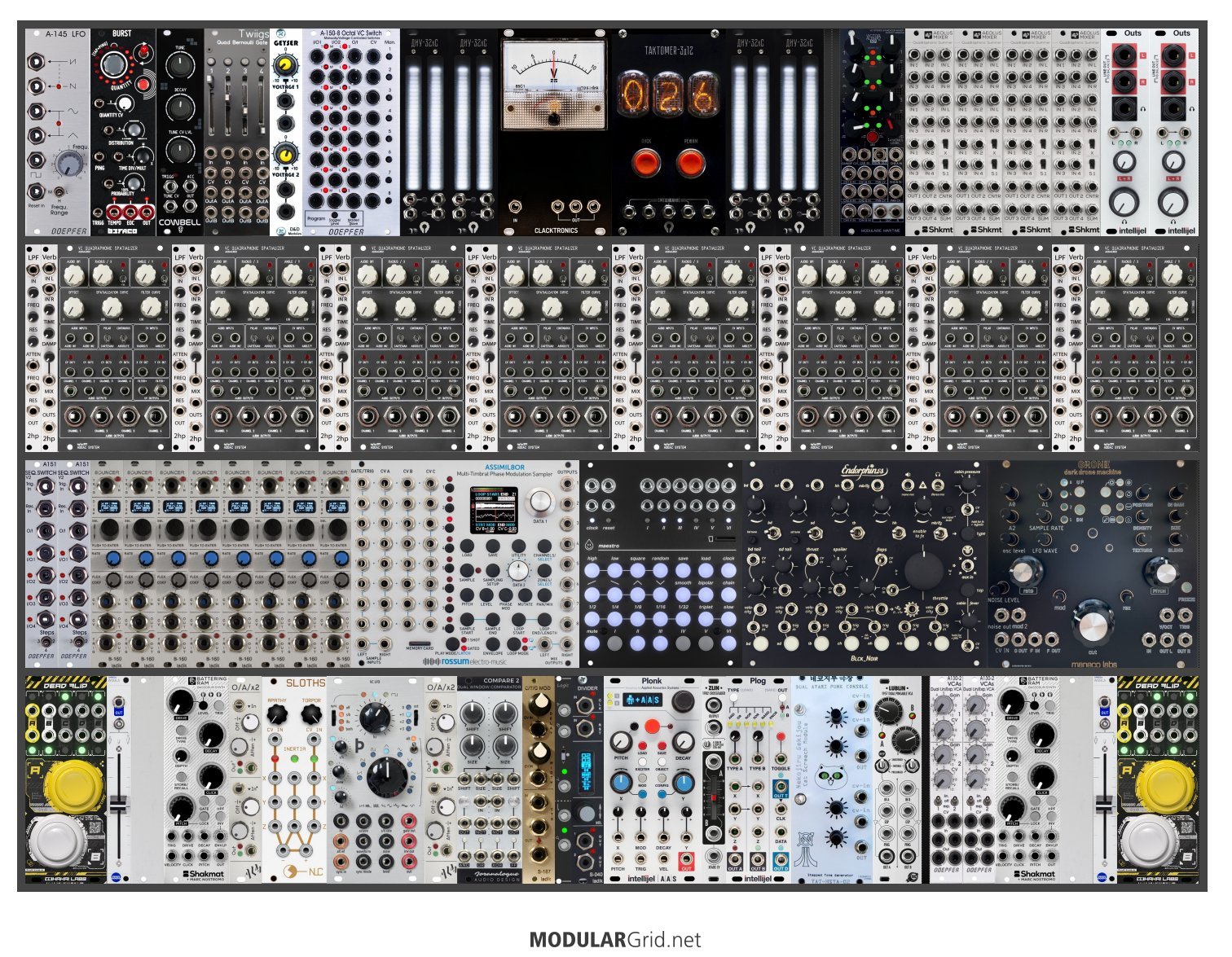
I couldn't resist. I set myself a rule of trying not to re-use any of the same modules as before, save for very basic stuff. As a result there's no radioactivity this time, but I present....quadraphonic cat pinball, complete with a score counter and a 'jackpot' function.

Getting the simple stuff out of the way: Doepfer A-145 LFO used as master clock. Acid Rain Maestro sequences Blck_Noir for rhythm. Maneco Labs Grone Drone Synth for background. It might not be radioactive but it can certainly sound ominous.

The rest simulates the pinball machine, and it's complicated. The Hakai Labs Dead Flip modules represent the flipper buttons, two on each side of the rack like a fancy pinball cabinet. The nearby SSSR Labs SM800a sliders represent the angle of firing the ball. These are the play controls. I placed a 4HP blank panel next to these to keep a little space for fingers. Pressing a button does several things. The OR output from the Dead Flip is routed to a Shakmat Battering Ram, playing the sound of firing off a "cat" when either button is pressed. Furthermore, a gate is sent to a Doepfer A-151 switch, which in turn routes it to one of the Ladik Bouncers. The output of each Bouncer is sent to one channel of Assimil8or, which is loaded up with cat samples. It might be more accurate to call these 'virtual feline cannonballs' rather than simple pinball: push a button and you get a boom sound, followed by a bouncing cat. The boom sounds from each feline flipper aka cat cannon are panned hard left and hard right to represent their position. But, each of the 8 channels of Assimil8or is routed to its own ADDAC803 Quadraphonic Spatializer, going through a dedicated LPF and Reverb first. The CV out from the Spatializer controls the reverb mix and the filter cutoff, so the sound changes realistically as each cat bounces farther away. Far out, man!

So far this just makes funny cat sounds, up to 8 bouncing cats simultaneously. But there's also a built-in game, and it keeps score. The Clacktronics voltmeter at the top represents a moving target in a fancy pinball game. The Thorn Audio LFO generates a voltage which drives this meter back and forth slowly. Sloth Chaos modulates this so it's not so easy to track. Imagine the target is a box, and your goal is to launch cats into it. The meter signal is fed into Joranalogue Compare 2, where it is compared against the slider voltage used to aim. If the aim is correct then timing is checked. The point is that it takes a bit of time for the cat to hit the target. This is done with the Ladik S-187 delaying the firing gate by a fraction of a second. The CatSynth Slimline Logic module & Intellijel Plog check if both the aim is correct and the timing is correct. If yes, that means a "hit", and several things happen:
-Ladik S-040 counts a hit towards the jackpot
-Plonk plays a hollow sound of an object striking the target box, which is panned by Xaoc Zlin so the location of the sound matches the position of the needle on the meter.
-Paratek Taktomer increments showing your score
If the logic check is a no that means a miss. None of the above happens, and instead:
-Error Instruments TAT Cat Soup plays an old-school video game bloop sound effect via Xaoc Devices Lublin. If you want the game to be easier, this could be panned via the Modulaire Maritime VA2XP, giving you some feedback of where you actually aimed vs. where the needle was located. If you want the game to be harder the sound do not patch CV to the panning function, it will be even stereo and therefore provide no positional feedback.

The Jackpot function: the Ladik S-040 can be set to an arbitrary count. When your score reaches this count, Befaco Burst is activated. This is set to output a large number of triggers. These hit the Erica Cowbell making the Jackpot sound effect. Those triggers are also routed to Twiigs and the A-150 Octal switch, which rapidly and randomly flashes the Paratek VU meters, simulating the blinking lights on a pinball cabinet when you get a high score. The D&D Geyser generates the extreme fixed voltages to make the VU meters flash completely on and off.

The difficulty is adustable in multiple ways. The size of the comparator window directly affects how easy it is to score a hit. Also, the rate and waveform of the Thorn Audio LFO will directly affect the movement of the "target". The faster it moves the harder it will be to hit. Also choosing a faster Sloth to modulate it would also make it more difficult. The number of hits required for the jackpot can be set in the Ladik S-040. The length of the delay set by the S-187 also affects difficulty. A short delay is easy, representing being closer to the target. A longer delay is more difficult.

Admittedly I did re-use Plonk and VA2XP as they are honestly perfect for this, but using a different percussion module or a different pannable mixer wouldn't really change the thought process.