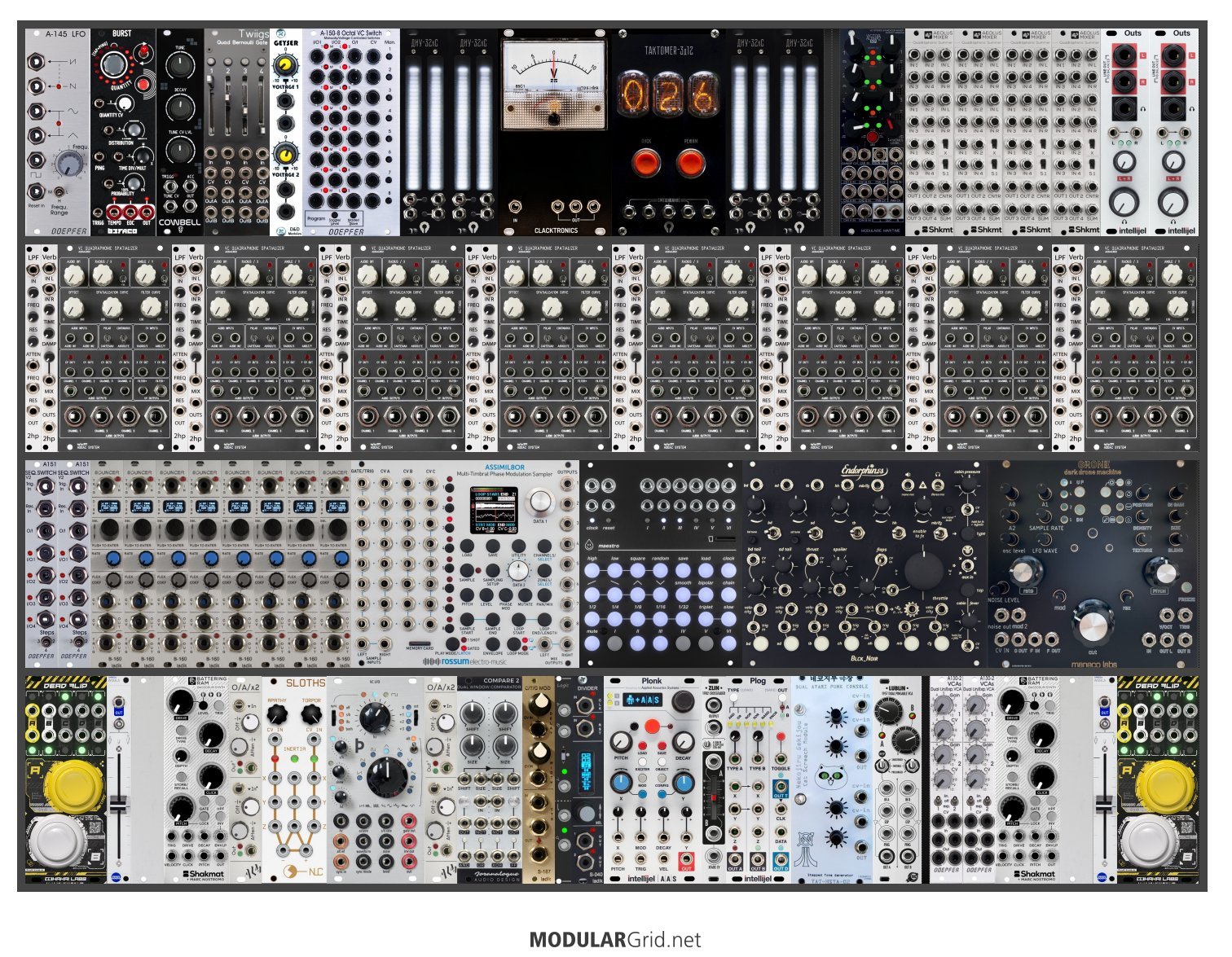
I was explaining modular to a co-worker. I said that modular synths can be set up for a wide variety of things, not just techno or EDM, and that someone could design a rack to be whatever they wanted. I then rattled off some examples: maybe a super complex drum machine, a wild effects unit for a guitar, or to use pinball physics to simulate a radioactive cat factory.
That made them spew their coffee all over the place, so of course I had to take a shot at it:
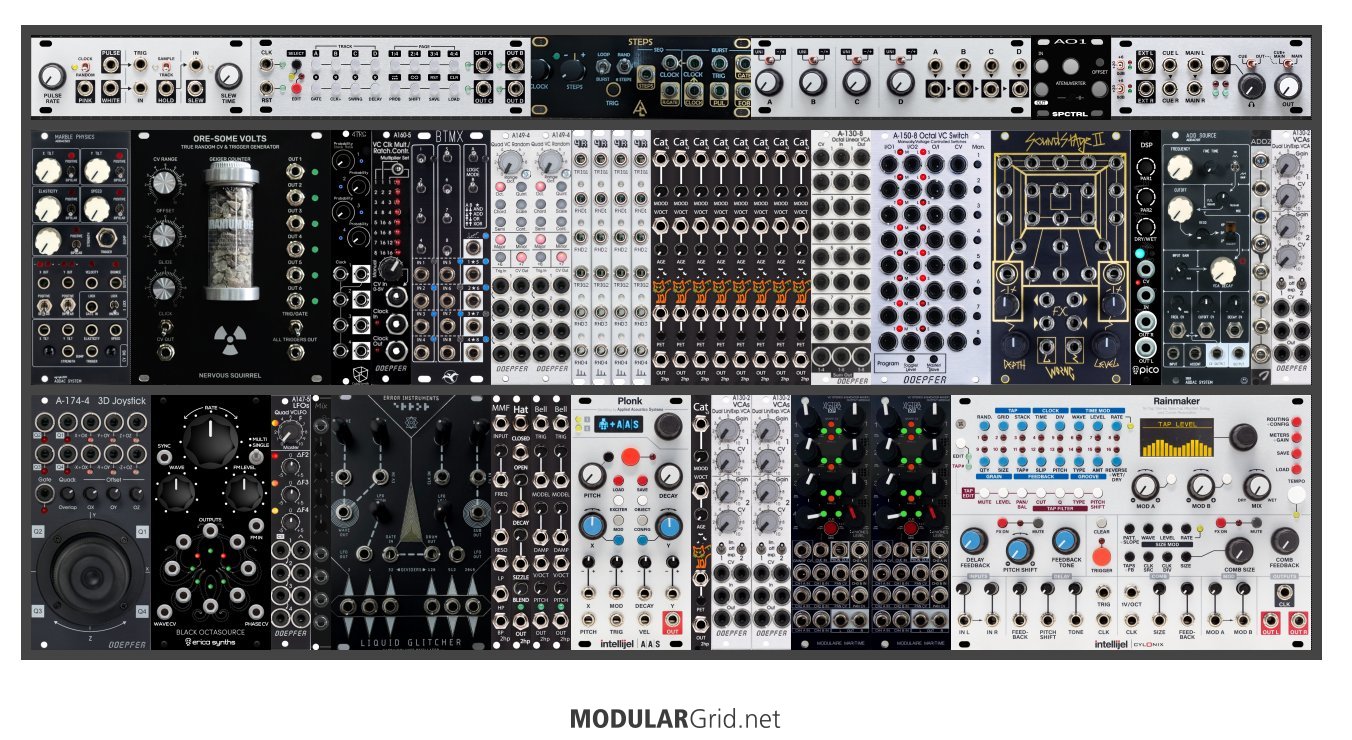
It starts out simple: ADDAC107 Acid Source for a bassline & Liquid Glitcher for some background machine sounds.
Rhythm: Steppy, Steps, A-160-5, and the 4TRG trigger the open Hat, two Bell modules, and the drum function of Liquid Glitcher to simulate factory machinery thumping and clanking. This would be mostly consistent but with a little randomness from the 4TRG, and the odd random burst of banging noises triggered by Steps played on the closed Hat.
The core of the setup is a choir of 8 Cat modules. These are mainly triggered by Ore-Some Volts, but that has 5 outputs and we need 8, so we get the other 3 using Noise tools, BTMX and Steppy. Most of these gates are thus truly random but due to the involvement of Steppy in the logic there will be a little bit of rhythm here too. These gates are processed by the two A-149-4's to generate volt/octave for the 'age' input on the Cat modules. The 4x Transient 4Rs are used to generate a total of 16 random CVs which randomize the volume and the 'mood' of the cat modules every time they are triggered. The Octal VC Switch decides which position in the SoundStage II that each Cat is routed to. So far we have a total of 8 cat voices positioned in 16 possible places around the virtual room. Rainmaker is patched into the FX loop of Soundstage II. Given the complexity of Rainmaker, we are now multiplying the number of cats sounding off by a very large number. There could be hundeds of cat sounds going off at once, with all sorts of nutty pitch and time-shifting effects involved.
Marble Physics and the Joystick tie it all together. The Joystick controls the X/Y tilt of Marble Physics and the button on the joystick fires the virtual ball. Marble Physics' bounce and velocity outputs trigger Plonk for the sound of the ball hitting the wall. That same gate is also sent through one channel of the 4TRG random skipper, and on to the 9th Cat module. This simulates the random chance of the pinball hitting a cat at the same time it hits a wall.
All the various sounds are mixed through a pair of VA2XP stereo mixers. Most of the channels have CV panning so we can do things like pan the Plonk & 9th cat sounds to accurately reproduce the location of the bounce in the stereo field, and pan the percussion sounds back and forth to simulate moving machinery. There is a lot we can do utilizing the CV from the joystick and Marble Physics.
There's an Octasource and quad LFO for misc. modulation purposes. Octasource can also be used instead of random CV for controlling the choir of cats. The rest is pretty self-explanatory, just some basic utilities.
Now that I think about it, this could be a fun challenge: given a theme and perhaps a budget (money and/or rack space), design your own rack to meet that theme.