
I couldn't resist. I set myself a rule of trying not to re-use any of the same modules as before, save for very basic stuff. As a result there's no radioactivity this time, but I present....quadraphonic cat pinball, complete with a score counter and a 'jackpot' function.
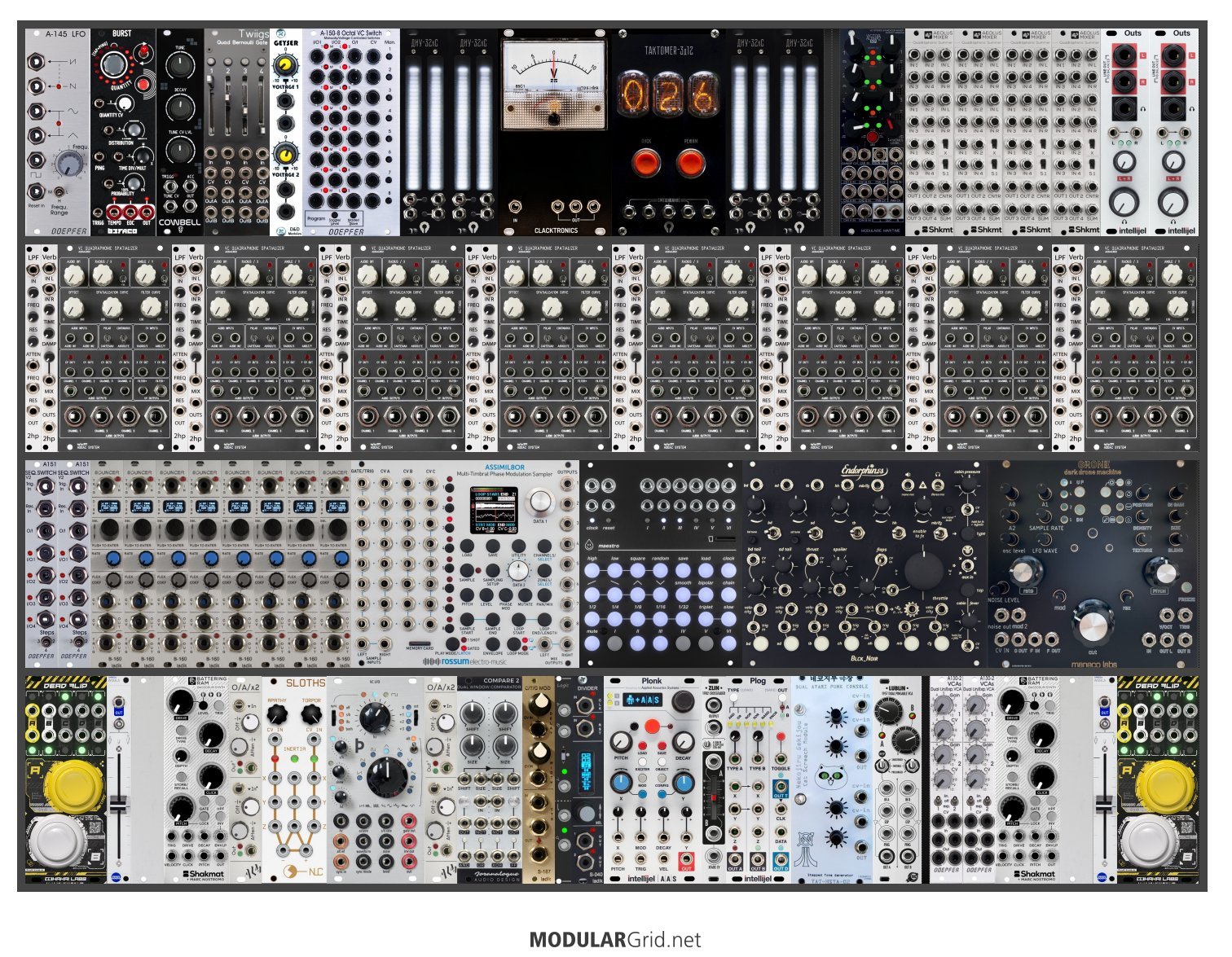
Getting the simple stuff out of the way: Doepfer A-145 LFO used as master clock. Acid Rain Maestro sequences Blck_Noir for rhythm. Maneco Labs Grone Drone Synth for background. It might not be radioactive but it can certainly sound ominous.
The rest simulates the pinball machine, and it's complicated. The Hakai Labs Dead Flip modules represent the flipper buttons, two on each side of the rack like a fancy pinball cabinet. The nearby SSSR Labs SM800a sliders represent the angle of firing the ball. These are the play controls. I placed a 4HP blank panel next to these to keep a little space for fingers. Pressing a button does several things. The OR output from the Dead Flip is routed to a Shakmat Battering Ram, playing the sound of firing off a "cat" when either button is pressed. Furthermore, a gate is sent to a Doepfer A-151 switch, which in turn routes it to one of the Ladik Bouncers. The output of each Bouncer is sent to one channel of Assimil8or, which is loaded up with cat samples. It might be more accurate to call these 'virtual feline cannonballs' rather than simple pinball: push a button and you get a boom sound, followed by a bouncing cat. The boom sounds from each feline flipper aka cat cannon are panned hard left and hard right to represent their position. But, each of the 8 channels of Assimil8or is routed to its own ADDAC803 Quadraphonic Spatializer, going through a dedicated LPF and Reverb first. The CV out from the Spatializer controls the reverb mix and the filter cutoff, so the sound changes realistically as each cat bounces farther away. Far out, man!
So far this just makes funny cat sounds, up to 8 bouncing cats simultaneously. But there's also a built-in game, and it keeps score. The Clacktronics voltmeter at the top represents a moving target in a fancy pinball game. The Thorn Audio LFO generates a voltage which drives this meter back and forth slowly. Sloth Chaos modulates this so it's not so easy to track. Imagine the target is a box, and your goal is to launch cats into it. The meter signal is fed into Joranalogue Compare 2, where it is compared against the slider voltage used to aim. If the aim is correct then timing is checked. The point is that it takes a bit of time for the cat to hit the target. This is done with the Ladik S-187 delaying the firing gate by a fraction of a second. The CatSynth Slimline Logic module & Intellijel Plog check if both the aim is correct and the timing is correct. If yes, that means a "hit", and several things happen:
-Ladik S-040 counts a hit towards the jackpot
-Plonk plays a hollow sound of an object striking the target box, which is panned by Xaoc Zlin so the location of the sound matches the position of the needle on the meter.
-Paratek Taktomer increments showing your score
If the logic check is a no that means a miss. None of the above happens, and instead:
-Error Instruments TAT Cat Soup plays an old-school video game bloop sound effect via Xaoc Devices Lublin. If you want the game to be easier, this could be panned via the Modulaire Maritime VA2XP, giving you some feedback of where you actually aimed vs. where the needle was located. If you want the game to be harder the sound do not patch CV to the panning function, it will be even stereo and therefore provide no positional feedback.
The Jackpot function: the Ladik S-040 can be set to an arbitrary count. When your score reaches this count, Befaco Burst is activated. This is set to output a large number of triggers. These hit the Erica Cowbell making the Jackpot sound effect. Those triggers are also routed to Twiigs and the A-150 Octal switch, which rapidly and randomly flashes the Paratek VU meters, simulating the blinking lights on a pinball cabinet when you get a high score. The D&D Geyser generates the extreme fixed voltages to make the VU meters flash completely on and off.
The difficulty is adustable in multiple ways. The size of the comparator window directly affects how easy it is to score a hit. Also, the rate and waveform of the Thorn Audio LFO will directly affect the movement of the "target". The faster it moves the harder it will be to hit. Also choosing a faster Sloth to modulate it would also make it more difficult. The number of hits required for the jackpot can be set in the Ladik S-040. The length of the delay set by the S-187 also affects difficulty. A short delay is easy, representing being closer to the target. A longer delay is more difficult.
Admittedly I did re-use Plonk and VA2XP as they are honestly perfect for this, but using a different percussion module or a different pannable mixer wouldn't really change the thought process.