Thread: Rackommend

That is interesting, I am curious how that works too. At first I was going to guess that maybe some of your oscillators were not tagged as such--I have seen many modules in the database which are not tagged with all of their functions. But all of those in your rack are marked as "oscillator", so that can't be it.

I wonder if it does the calculation not by the number of modules, but the number of functions instead?

As a really simplistic example: Suppose we have a rack with only two modules in it: a Behringer Brains and a Wasp filter. If we're counting by the number of modules we have one oscillator out of two total, so 50% oscillator. However, if we are counting by function instead we have one oscillator out of a total of 5 functions: Drum, Noise, Oscillator, and Synth Voice from Brains + Filter from the Wasp. That calculation gives 20% oscillator.


Actual coaxial. The point is to shield the signals against interference and cross-talk.


In my opinion the best option is to wire up each pair of jacks with shielded cable. That would mean 8 coaxial cables going left-to-right.


Does this work as I’m imagining it?
Is the Q-Slider output suitable for controlling the CV input of the A-130-8V in this way?
Would this give me a useful and reasonably smooth range for manual volume performances?
Are there any problems with using the Q-Slider's M-IN / MAX settings to calibrate the VCA range?
-- lexy82

Yes, that will work as you describe, though you will have to make adjustments to the A-130-8. The QSlider outputs either 0-10V or +/-5V. The A-130-8 expects 0-5V "out of the box", but it has trimmers on the back that you can adjust to get 0-10V instead. So you would set the QSliders to 0-10V and then adjust the A-130-8 to match. That would do exactly what you want.


I couldn't resist. I set myself a rule of trying not to re-use any of the same modules as before, save for very basic stuff. As a result there's no radioactivity this time, but I present....quadraphonic cat pinball, complete with a score counter and a 'jackpot' function.
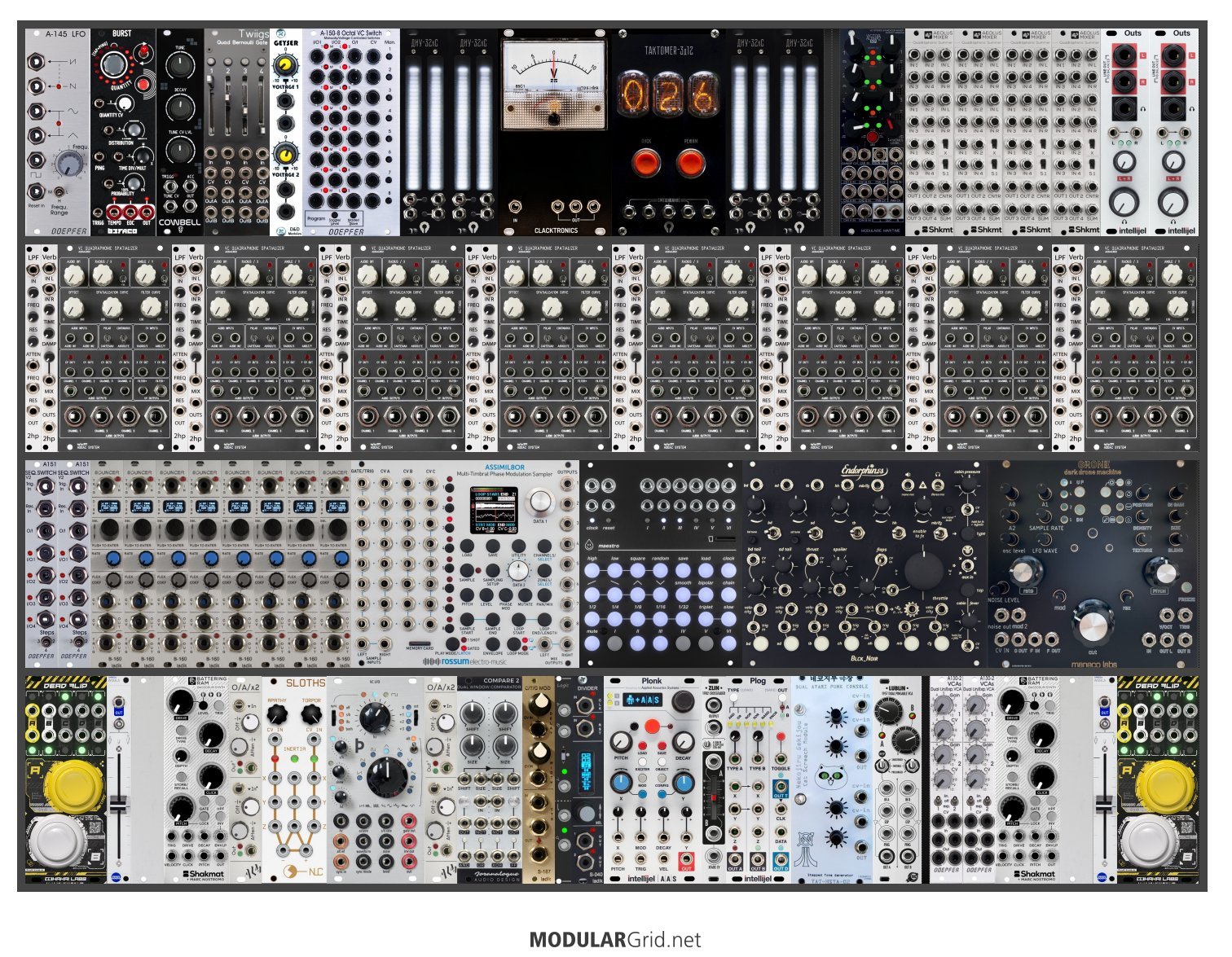
Getting the simple stuff out of the way: Doepfer A-145 LFO used as master clock. Acid Rain Maestro sequences Blck_Noir for rhythm. Maneco Labs Grone Drone Synth for background. It might not be radioactive but it can certainly sound ominous.

The rest simulates the pinball machine, and it's complicated. The Hakai Labs Dead Flip modules represent the flipper buttons, two on each side of the rack like a fancy pinball cabinet. The nearby SSSR Labs SM800a sliders represent the angle of firing the ball. These are the play controls. I placed a 4HP blank panel next to these to keep a little space for fingers. Pressing a button does several things. The OR output from the Dead Flip is routed to a Shakmat Battering Ram, playing the sound of firing off a "cat" when either button is pressed. Furthermore, a gate is sent to a Doepfer A-151 switch, which in turn routes it to one of the Ladik Bouncers. The output of each Bouncer is sent to one channel of Assimil8or, which is loaded up with cat samples. It might be more accurate to call these 'virtual feline cannonballs' rather than simple pinball: push a button and you get a boom sound, followed by a bouncing cat. The boom sounds from each feline flipper aka cat cannon are panned hard left and hard right to represent their position. But, each of the 8 channels of Assimil8or is routed to its own ADDAC803 Quadraphonic Spatializer, going through a dedicated LPF and Reverb first. The CV out from the Spatializer controls the reverb mix and the filter cutoff, so the sound changes realistically as each cat bounces farther away. Far out, man!

So far this just makes funny cat sounds, up to 8 bouncing cats simultaneously. But there's also a built-in game, and it keeps score. The Clacktronics voltmeter at the top represents a moving target in a fancy pinball game. The Thorn Audio LFO generates a voltage which drives this meter back and forth slowly. Sloth Chaos modulates this so it's not so easy to track. Imagine the target is a box, and your goal is to launch cats into it. The meter signal is fed into Joranalogue Compare 2, where it is compared against the slider voltage used to aim. If the aim is correct then timing is checked. The point is that it takes a bit of time for the cat to hit the target. This is done with the Ladik S-187 delaying the firing gate by a fraction of a second. The CatSynth Slimline Logic module & Intellijel Plog check if both the aim is correct and the timing is correct. If yes, that means a "hit", and several things happen:
-Ladik S-040 counts a hit towards the jackpot
-Plonk plays a hollow sound of an object striking the target box, which is panned by Xaoc Zlin so the location of the sound matches the position of the needle on the meter.
-Paratek Taktomer increments showing your score
If the logic check is a no that means a miss. None of the above happens, and instead:
-Error Instruments TAT Cat Soup plays an old-school video game bloop sound effect via Xaoc Devices Lublin. If you want the game to be easier, this could be panned via the Modulaire Maritime VA2XP, giving you some feedback of where you actually aimed vs. where the needle was located. If you want the game to be harder the sound do not patch CV to the panning function, it will be even stereo and therefore provide no positional feedback.

The Jackpot function: the Ladik S-040 can be set to an arbitrary count. When your score reaches this count, Befaco Burst is activated. This is set to output a large number of triggers. These hit the Erica Cowbell making the Jackpot sound effect. Those triggers are also routed to Twiigs and the A-150 Octal switch, which rapidly and randomly flashes the Paratek VU meters, simulating the blinking lights on a pinball cabinet when you get a high score. The D&D Geyser generates the extreme fixed voltages to make the VU meters flash completely on and off.

The difficulty is adustable in multiple ways. The size of the comparator window directly affects how easy it is to score a hit. Also, the rate and waveform of the Thorn Audio LFO will directly affect the movement of the "target". The faster it moves the harder it will be to hit. Also choosing a faster Sloth to modulate it would also make it more difficult. The number of hits required for the jackpot can be set in the Ladik S-040. The length of the delay set by the S-187 also affects difficulty. A short delay is easy, representing being closer to the target. A longer delay is more difficult.

Admittedly I did re-use Plonk and VA2XP as they are honestly perfect for this, but using a different percussion module or a different pannable mixer wouldn't really change the thought process.

Thread: Bug Report

I've noticed a different bug. Sometimes if I delete a module from a rack, or 'cut' it out using CTRL+X, the module itself will disappear, however that module's gray information window--the one that usually pops up when you mouseover a module--will remain on screen, moved to the upper left corner, and never goes away. Refreshing the page fixes the problem. I've tried to replicate the bug deliberately and I haven't been able to do so consistently, but it does happen sometimes.


Though as you have no plans to actually construct this you could argue that people have no actual reason to comment on it, what feedback do you actually require?

To be honest the main reason I posted it was to share with my friend as a joke. I suppose I could have simply sent a screenshot but sharing the rack here means he can mouse-over the various modules and read what they do.

I was also hoping to perhaps spark a game of sorts where someone suggests a rack idea, silly or not, and others attempt to complete the challenge. I know I'd find that fun and a good way to learn outside my comfort zone.

That said, I would absolutely welcome feedback or criticisim so long as it is specific!

All your other rack plans(?) are private, could you make public the Racks that you do actually own or plan to build so that people have the opportunity to actually comment on what you do have or will create?
-- wishbonebrewery

Right now my other racks in Modulargrid are a bit of a mess. I have a large polyphonic system and I'm right in the middle of rebuilding it; I am building a new case in my workshop having outgrown my current one (27U 168HP). I have probably 800 HP worth of modules in boxes waiting to go in the new rack. What I really need to do, but haven't had the time yet, is to upgrade to a Unicorn account and re-arrange everything.

My rack is set up like an industrial control console, 3 rows of modules (9U) more-or-less horizontal, the other rows vertical. I try and keep modulation sources, VCAs, and the like towards the back of the horizontal section, and input devices (joystick, keyboards, etc) at the very front of it. I mentally split the vertical section into sort of a "U" shape that matches my workflow. Sequencers at the upper left. Oscillators next. Envelopes & filters after that. Effects towards the right. Output at the upper right. I do not use a DAW; I use computers often enough, I don't want one around when I am playing music.

Really the only system advice I'm looking for is some recommendations for Tube VCAs. I made a separate post about that but nobody has weighed in.


I was dumb and arrogant, and I apologize.

Apology accepted. And thank you, we need more of this sort of reflection in online forums.

Mostly, it's the wires that people forget:
Are there enough distribution points to connect and control and share those ten-things-all-alike?

Yes, I think so. I explained how the patch would work, and I went through quite a lot of effort in thinking about what modules needed to be present. If there's a specfic flaw you've spotted then please point that out.

Should those ten-things-all-alike, and the other-thenty-things that they'll require to work, be interleaved instad of in banks?
Will you have to drape wires from the northwest to the southeast over and over to get what you're hoping to hear,
covering up the good stuff in the middle?

This rack is better thought of as a word problem in Math class. It has only one goal, and that goal does not invovle twiddling with tiny knobs on the 2HP modules. I am left-handed, so I put the most critical controls--the Joystick, Marble Physics, and the LFO's on the left where they are easiest for me to access them. Were I nutty enough to actually build this I'd patch it up with Tendrils Stakkas and leave the wires alone. It's not a standard rack where one expects to constantly move cables around. Also, keep in mind that a big part of this rack design is essentially a joke. Keeping the modules grouped together might not be so playable but it instantly conveys what is actually going on in the rack when someone looks at it. Even someone like my friend who has no idea what most of these modules actually do can see 8 "cats" in a row and think wow, that's a lot of cats.

Is this layout truly optimal and perhaps it could be better with some of the modules moved around? That is valid criticisim, and I'd be happy to hear that. Which modules do you think I should swap or move? What layout do you think is better? Nobody learns anything without specifics.

Those here that have put four or more 2hp modules all in a group must have felt that 'uh-oh' once they hooked them all together.
It seems like a cool idea, but it's really hard to get and keep them dialed in because it's so cramped and touchy.

I totally agree that larger modules are more playable. However, that wasn't part of the problem I set for myself. I picked those 2HP modules for a few reasons. The budget is absurd enough as it is, using larger modules would have made that even worse. I also thought the names of the modules fits the theme well. We've got 9 cats (9 lives!), a couple bells, a hat....that gave me a chuckle. I suppose given that this was just a fantasy project with no money being spent I could have made the rack much bigger but I thought it was getting a bit big already and one has to draw the line somewhere. If you have a different take on it then I'd love to see what you came up with.

So that's it.
Think Systemic.

If we were talking about most racks I would totally agree with you. But again, I am approaching this as a singular thought exercise, not designing a rack that I'd actually be playing.


Needs more Cats :-)
-- breyten

I just spotted the new Hakai Labs "Dead Flip" module...very pinball, so I think I'll take another stab at it. But I think it would be more interesting to use entirely different modules this time.

When I was first getting into modular I learned a lot from Rob Scallon and Andrew Huang's youtube video "The Most Expensive White Noise Machine". The fundamental premise of the video is very silly. I don't think anyone is building expensive modular synths to simulate beach sounds. However, the video is a great way of explaining the concept of building up a patch completely from scratch and layering various individual sounds, module selection, and so on. Once I got enough modules in my own rack I started challenging myself to do random sound design tasks inspired by that because it's a great way to get out of one's comfort zone and learn more. It's easy to get stuck in a groove but if you make yourself attempt to patch say, a Spaghetti Western soundtrack complete with random gun duels, or an Anime mecha fight, you are forced to learn new functions of modules you already own and new ways to combine them. Designing fantasy racks isn't as good as actually patching but you're still thinking outside your comfort zone, especially if you impose various restrictions on yourself.

I wonder if 2HP could be convinced to produce a limited-edition Hyrax module? Like the "Cat", but with hyrax sounds instead. The internet's latest favorite meme animal happens to have a huge repertoire of interesting sounds, not just the "awawa"...


Can you kindly point me to the forum rule that discusses this so I can make sure I'm complying with all relevant policies?


Who said anything about a collection? I though it was rather obvious this was a silly idea and nothing more. Is making rack designs for fun or as a mental exercise forbidden on this forum?


Pam's is a wonderful master clock and is one of the most common modules in all of Eurorack but if you're using your MPC live for your clock then there's really no need for it in your case.

I agree with noodle_hut about getting an active mult instead of the passive. I prefer to use splitters or stack cables over passive mults because they take up no rack space. If you're going to spend rack space on a mult, make it active.

If you need VCAs there are tons of options. Intellijel Quad VCA is very popular, it's capable and it's reasonably priced. Mutable Instruments Veils is also very popular; MI is out of business now but there are many clones available. Other good basic VCA choices are Xaoc Devices Tallin and Doepfer A-130-2. Tallin can be used as a standard VCA but also has some pretty sweet overdrive/distortion if you want that. Another good VCA option is the ADDAC802 or 802R. These two modules are functionally the same, the only difference is the -R version re-arranges the location of the knobs & sockets. This can be used as 5 individual VCA's, as a 5-channel mixer, or various combinations of mixing and VCA use. The cool thing about this module is that it has a three-position switch for every channel, so you can instantly mute a channel by switching it off, or you can choose which output you send the signal to, so it can act like 2 mixers at once.

"Mixers" is a broad subject in Eurorack and can be nearly anything. Some are tiny and simply add signals together with no real control, say the Journaloge Add2. Then on the opposite end of the spectrum you have something like the ADDAC807 which is huge, very expensive, and is basically the same thing as a full featured studio mixer. It's hard to give advice without knowning what specifically you want to use the mixer for and there are so many options, but for small systems I like the Modulaire Maritime V2AXP. It's compact and has CV panning so you can also use it for cross-fading your sounds into your stereo mix. However, I don't know how useful the mixer would be for you because currently you only have one sound source: Ballista Blast. I'm assuming you would route that through Multigrain and then to your output. There's no real need for a mixer unles you add other sound sources (oscillators or voices) to your rack.

Likewise there are zillion options for envelopes. Xaoc Zadar is a very popular quad envelope, but it's also not that 'playable', if that makes sense, because of its controls. Many people prefer more old-school ADSRs with a knob or slider for each control, but those often take up more room in your rack. However I am not sure that you necissarily need them. Envelopes are important for basic subtractive synthesis: That works by having an oscillator constantly producing a signal and the envelope is what "lets the sound out" to play only the specific notes you want rather than a constant steady tone. Usually another envelope is used to control filter at the same time. However, that works in conjunction with a basic oscillator & a seperate filter and you didn't mention any of those. Ballista Blast is a complex oscillator which already has its own envelopes and filters built into the module. Unless I am missing something I don't think you have much of a need for envelopes with what you've described so far.


I totally understand why you would want to move modules around. I also know what you mean about having a mini rack for focusing on a specific module without having it tied to your main studio. I have basically that same setup: a big rack in my studio, and a much smaller portable case I can carry around wherever if I want to concentrate on a specific module. I equipped it with some basic utilities and a few leftover modules that I bought when I first started out but have since retired from my main studio rack. It's about half full so there's plenty of room for testing out a new module. Also, it was a handy place to put modules before I completed building my full-size case.

I think my biggest hangup is the size of the cassette in the image, though the more I think about it it's a difficult balancing act. The larger the cassettes are the less advantage they have compared to individual powered cases. A large cassette forces you to swap many modules while you may only want to swap one or two, and it's actually a bit more complicated for traveling. A powered case can go anywhere that has electricity. Traveling with a cassette requires you to make sure your destination has a cassette-ready case waiting for you. You can circumvent that problem by bringing your own case, but at that point the cassettes are superfluous. The smaller the cassettes are the more interesting the module-swapping possibilities become. The design you created could easily be made narrower to scale it down. However, the smaller you make the cassettes then the more HP you give up in a large rack for the space taken up by the latches. And of course the cost goes up because you're having to buy more cassettes. I think determining the sweet spot in the cassette size is going to be all-important.

I totally agree that it makes sense to 3D print these before having anything machined, if it's one thing that 3D printers are good for it's this kind of prototyping. Also, now that I think about it, you could probably also make the cheeks of the frames out of bent sheet aluminum. Modern sheet-metal forming presses can insert hardware like threaded inserts, studs, standoffs, etc automatically so companies like Protocase, etc, could make those quite economically.

I am sure I could build a nice, workable, "flip" style case. The problem is that it would be a lot of work as there are a lot of little details to worry about. The latch on the flip portion needs to be well thought out because if it feels awkward to use or doesn't lock securely then it would ruin the ergonomics of the whole thing. Commercial-quality door latches seem like a good choice since they are meant to handle high duty cycles, but where exactly to locate them and how to control them? Where to put the lock handle and how to make it work? And there also needs to be some provision to balance the rack because if it ends up wanting to flip one way or another due to gravity that could make operation difficult. Perhaps operating the latch simultaneously applies a friction brake to ensure it doesn't move until you can put your hand on it? Maybe have some kind of rotary damper on the axle to limit its rotation? I'm sure I could address all those things, but it would be a complex, expensive project that is ultimately a gamble in the end. I could foresee it being perfectly functional but awkward to use, and I'm not sure I'm willing to roll the dice on that yet.


I wonder if this behavior is deliberate on the part of Reverb just to get more traffic to the site? If Reverb's API feeds a dead link then sure, nobody can buy that item anymore, but they might be tempted to buy something else on Reverb. If there is no link there is no chance of a sale at all.


Thread: Tube VCAs

I'm looking to pick up some tube VCAs for my rack. I'm currently leaning towards Metasonix RK2 or Trogotronic M277. I'd appreciate it if anyone could weigh in on this. Metasonix is quite a bit more expensive,

Power is not a concern.


Could it work? Absolutely. The basic idea has been used for all sorts of computer/data applications for years. It's also not too far from the concept of mounting your modules in standard 19" rack hardware.

But I'm not really sure what advantage this gets you*. You're not able to move individual modules around easily, instead you move them around in groups installed in fairly large "cassettes". At that point, there's not much functional difference between a "cassette" and a small powered case. You can stack small cases to make a larger rack, and you can use them individually without having to plug them into to a larger apparatus. I wonder if 19" industrial racks or stacking smaller self-powered cases could acheive the same goal, but maybe this suits your needs better, so long as it was designed & fabricated carefully it would work.

I think you could improve this design by replacing the L-angle with perforated sheet metal bent to shape. That would be stronger and would provide electrical sheilding while still allowing airflow. I also think making the cheeks and the levers out of aluminum would look a lot better and be more durable, that little detail would make this look like something out of an aircraft or spaceship which I think would be very cool.

  • I fibbed a bit when I said I couldn't see any advantages. I do think the easy access to the rear of the busboard is an advantage. My biggest gripe about re-arranging modules, especially with a large case, is that sometimes it can be a real hassle to plug/unplug modules from the busboard. Having access from the back is one way to solve that problem. However, if you're re-arranging your modules in groups (cassettes or individual powered racks), how often are you having to deal with that problem anyway?

I've been thinking about a different challenge: If one has a very large system, how to access a lot of modules without having to stand up-and-down so much. One idea that came to mind was inspired by old-fashioned lecture halls which had flip-around double sided chalkboards. A teacher would write on one side, when that was filled up and they needed more space they would flip it over and write on the other side. If at any time if they needed to refer back to what they originally wrote it just took a second to flip the board over again. A rack could be built like this: Imagine taking two racks, attaching them together back-to-back, and then having a central axle about which this entire assembly can be flipped around quickly and easily. That central axle would be hollow and would contain power cables & breakouts. The only major disadvantages would be:
a) you couldn't simuntaneously tweak modules on opposite sides of the flip rack
b) patch cable positioning could get complicated

I don't think these are killer disadvantages. Problem a already exists for large systems. Problem b can be dealt with by providing breakouts built into the rack. Some would go front-to-back between the two faces of the flip rack. Others would go out from the flip rack, through its hinge, to allow connection to modules elsewhere in the system. I'm imagining the finished product to look like an upright piano. It would sit on the floor, have 3 or 4 rows of modules oriented mostly horizontally, sort of like a desk or a standard keyboard position. These would not "flip". A vertical section would sit above, with most of it being the flip rack. A robust latch (foot operated?) would allow this to unlock and be flipped around. Part of the vertical section would be stationary and would contain the breakout connections as well as more space for modules that would not flip.

Of course, it's not ideal that you can't tweak both sides of the flip rack simultaneously. However, the trade-off is that you have easy (albeit not perfect) access to a lot more modules in the same amount of floorspace, and you absolutely can play that many modules simuntaneously thanks to the breakouts.


Oh, I'm not going to actually assemble this thing. I might be a bit crazy but I'm not that crazy!


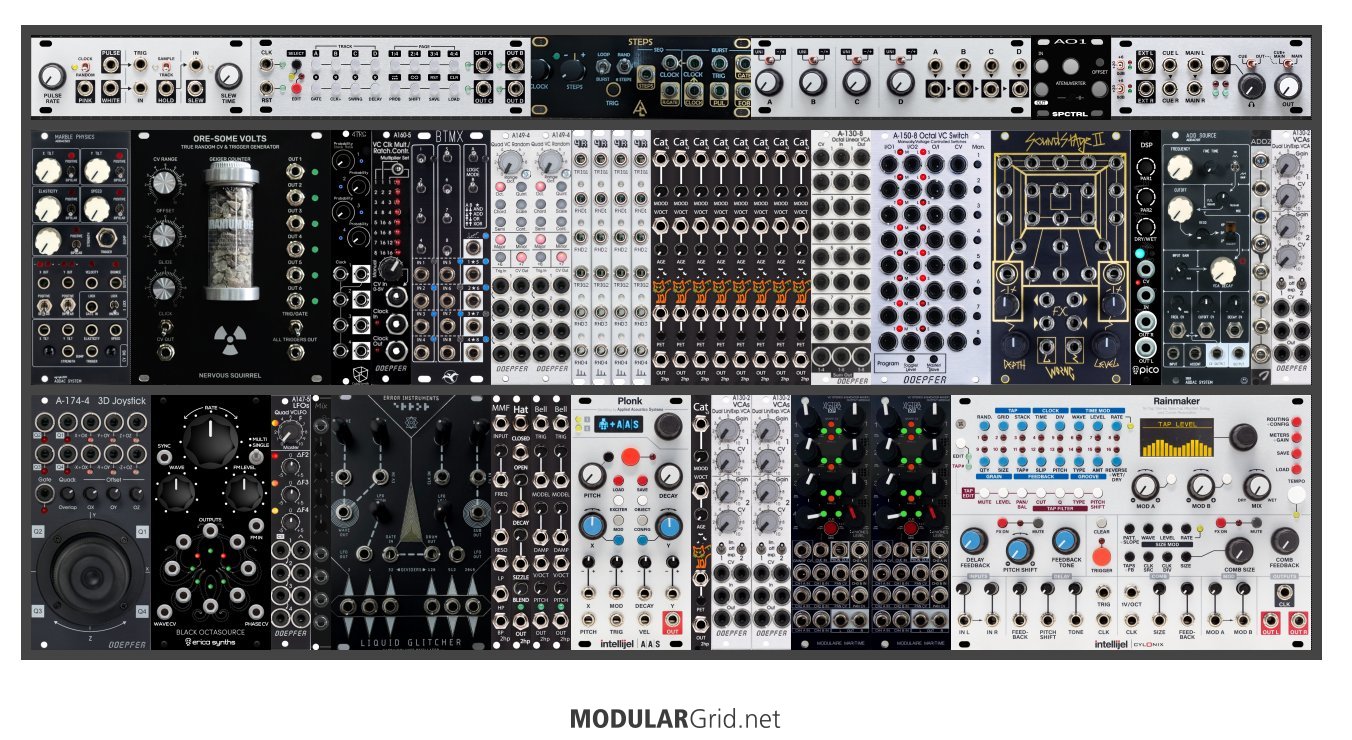
I was explaining modular to a co-worker. I said that modular synths can be set up for a wide variety of things, not just techno or EDM, and that someone could design a rack to be whatever they wanted. I then rattled off some examples: maybe a super complex drum machine, a wild effects unit for a guitar, or to use pinball physics to simulate a radioactive cat factory.

That made them spew their coffee all over the place, so of course I had to take a shot at it:

It starts out simple: ADDAC107 Acid Source for a bassline & Liquid Glitcher for some background machine sounds.
Rhythm: Steppy, Steps, A-160-5, and the 4TRG trigger the open Hat, two Bell modules, and the drum function of Liquid Glitcher to simulate factory machinery thumping and clanking. This would be mostly consistent but with a little randomness from the 4TRG, and the odd random burst of banging noises triggered by Steps played on the closed Hat.
The core of the setup is a choir of 8 Cat modules. These are mainly triggered by Ore-Some Volts, but that has 5 outputs and we need 8, so we get the other 3 using Noise tools, BTMX and Steppy. Most of these gates are thus truly random but due to the involvement of Steppy in the logic there will be a little bit of rhythm here too. These gates are processed by the two A-149-4's to generate volt/octave for the 'age' input on the Cat modules. The 4x Transient 4Rs are used to generate a total of 16 random CVs which randomize the volume and the 'mood' of the cat modules every time they are triggered. The Octal VC Switch decides which position in the SoundStage II that each Cat is routed to. So far we have a total of 8 cat voices positioned in 16 possible places around the virtual room. Rainmaker is patched into the FX loop of Soundstage II. Given the complexity of Rainmaker, we are now multiplying the number of cats sounding off by a very large number. There could be hundeds of cat sounds going off at once, with all sorts of nutty pitch and time-shifting effects involved.
Marble Physics and the Joystick tie it all together. The Joystick controls the X/Y tilt of Marble Physics and the button on the joystick fires the virtual ball. Marble Physics' bounce and velocity outputs trigger Plonk for the sound of the ball hitting the wall. That same gate is also sent through one channel of the 4TRG random skipper, and on to the 9th Cat module. This simulates the random chance of the pinball hitting a cat at the same time it hits a wall.

All the various sounds are mixed through a pair of VA2XP stereo mixers. Most of the channels have CV panning so we can do things like pan the Plonk & 9th cat sounds to accurately reproduce the location of the bounce in the stereo field, and pan the percussion sounds back and forth to simulate moving machinery. There is a lot we can do utilizing the CV from the joystick and Marble Physics.

There's an Octasource and quad LFO for misc. modulation purposes. Octasource can also be used instead of random CV for controlling the choir of cats. The rest is pretty self-explanatory, just some basic utilities.

Now that I think about it, this could be a fun challenge: given a theme and perhaps a budget (money and/or rack space), design your own rack to meet that theme.


Thread: New rack

VCAs are a must. Intellijel Quad VCA is great, it's 4 VCAs and it can double as a basic mixer, and they're not very expensive. You could also go with two Xaoc Tallins, those have a nice overdrive effect built in. Or a couple Doepfer A-130-2's

You also need some dedicated mixing that you can use without having to repurpose your VCAs. I'd look for a stereo mixer for your output and also at least one small mixer or averager you can use for CV or sub-mixes, like your drums. Jornalouge Add 2 is very useful and compact. I like the Doepfer A-138-j a lot too.

Ghost is a good module but you might want some other effects. I'm not really sure what your goal is so I'm not sure what exactly to recommend. Likewise Ochd is a great module too, but I think you could benefit from some more complex LFOs too. The Zadar and Batumi that stefvanriet mentioned can do this, there's also Intelijel Quadrax and loads of others.

Other envelopes/utilities that would be useful: Maths of course, also Schlappi Boundary or Cosmotronic Delta-V as an alternative.


Thread: Bug Report

I am encountering a bug with the "Copy Screenshot URL" function. I used that to get a screenshot of a rack so I could put it in a forum post. It worked so far, it gave me a link and the image looked correct in my browser and also in a preview window working on my post. I made some changes to the rack and then went to use the "Copy Screenshot URL" link again to get an updated image after making the changes. But now it doesn't seem to update. The link generates the same URL, and the image is exactly the same as before. The link still shows the first version of the rack, before I made edits. I make sure to force my browser to reload the link to make sure I wasn't seeing an old cached version and that doesn't seem to be the case. I forced a reload in my browser and it still keeps showing the old image.


I share concerns that others have about the feedback system. First, I think limiting the feedback to simply positive or negative is less than ideal. Right now there is no real way to talk about relatively minor problems without going full negative, and that means that legitimate issues go unreported.
I have had multiple situations where I purchased a module from a member and there was some significant issue, even thought I ultimately did receive the module. These sellers were not scammers so I don't think it is fair or appropriate to leave negative feedback, yet at the same time the situations were not perfect either. The feedback system needs to allow for more nuance, perhaps adding a neutral option, or at the very least adding the opportunity for comments. This way people could say things like "the module was perfect as described but the seller took a month to ship it", or "the seller's communication was good but they didn't pack it safely", etc.

Second, some members leave feedback for traders they have never actually completed a transaction with. I have bought modules from members who had some negative feedback on their profile. Before deciding to transact with them I did my due diligence and asked those members who left negative feedback to describe the situation in PMs. I wanted to know if the seller was a scammer, a slow shipper, or maybe there was just some misunderstanding and the seller was being unfairly blamed for someone else's mistake. Some members replied that they never actually bought anything from the seller they had left negative feedback for--they disagreed about the price & fees up-front and never agreed on a deal. No money or modules changed hands, yet negative feedback was posted. I think this is wrong. If people disagree on terms and walk away from a deal that's their decision, and that's totally OK. But if you never agree on a deal in the first place and nobody ever sent a module or money, what are you leaving feedback for, exactly? The point of feedback is to review a transaction. If there was no transaction there is nothing to review. To make matters worse, some of these negative feedback comments come from buyers with unreasonable expectations. I don't know the best way to address this problem, but I have an idea. Instead of allowing feedback automatically when someone responds to an ad, instead create a 'deal' page with a text box and two approval checkboxes. The buyer and seller can edit the terms in the text box, and then both parties have to click "OK" to approve and finalize the deal, sort of like a 'trade window' in video games. Only after both parties have "agreed" to the deal can anyone leave feedback. That probably has some downsides I'm not thinking of, but it's an idea to hopefully inspire other improvements.


Agreed, it looks awesome, and super 'playable' at the same time. Sadly, as I understand it, this module never made it into production. I remember reading somewhere that they made a handful of prototypes but for whatever reason it never went beyond that.


Off-topic, but what is up with the Plexiphon delay? (delay as in "arriving late").

I think they shipped some out but the first batch was very small. I am very interested in trying it out but it seems that everyone is still sold out right now.
I'm also very curious about the Xaoc Budapeszt but those have not been released yet.


That's what, 18 HP to fill?

I'm thinking:
Beehive (micro Plaits clone), 8 HP - Wavetable oscillator
Xaoc Tallin, 6 HP - 2 more VCA's with overdrive/distortion
Then pick some 4HP utility, maybe a Disting mk4, FX Aid, Divkid Trace or ochd...

You could save a little space by replacing the Line In, Line Out, and Headphones modules with a single Stereo I/O 1U. That will do the same thing but in 20 HP instead of 30. If you do that, and get rid of the 6hp blank, you can free up 16 HP of 1U space. You could then fit a Nonlinearcircuits Sloth Chaos & a Shakmat Tessitura Tailor.


I have noticed this issue with out of date Reverb listings showing up well after the listing ended too.

I can cite an example: Right now you can look up the Pittsburgh Modular Lifeforms Touch Controller and it shows 1 listing on Reverb:
https://modulargrid.com/e/pittsburgh-modular-lifeforms-touch-controller

However, that Reverb listing sold in early May, almost 4 months ago.


Shout out to @ModularFlow for a smooth international transaction on a Metasonix tube module. Communication was great, price was fair, module arrived in good order. Thank you!


the example of snap-on being the inventor of ratcheting socket wrenches is totally incorrect - the patent was filed over 50 years before snap-on was founded... the other companies are NOT copying snap-on! - if you don't believe me go to wikipedia and look at the pages for snap-on and socket wrench!! the 1864 patent is clearly mentioned on the socket wrench page and no mention of a patent is cited on the snap-on (founded 1920) page - the snap-on marketing slogan is just that - marketing! what snap-on may (or may not) have innovated with is their sales method...
-- JimHowell1970

I did not mean to imply that Snap-On invented the idea of the socket wrench, but they certinainly created the version of it which is well known today. Whether or not they were the original inventor is besides the point here, the point is their specific design has become a standard, and was copied by bigger companies down to every last cosmetic detail: the handle shape, the location of the decorative grooves around it, the shape of the head, the way the pawls work inside, etc. It's no different than the situation with Maths, for example. Make Noise, like Snap-On, wasn't the first: Buchla started it. Serge refined it. Make Noise refined it further. In the end Maths, like Snap-On, became the standard. And then, others started knocking it off, even down to the minor cosmetic details. As I mentioned before, a Harbor Freight ratchet is a much closer copy of a Snap-On than an Abacus is a copy of a Maths. If you want another example go compare a Harbor Freight pliers wrench with a Knipex.

beds, for example, have been around for thousands of years - the earliest known mattress is 77000 years old, bookcases have almost definitely been around since the earliest book (wikipedia says roughly 1500 years) and the concept of shelves in an open box, as a piece of furniture probably pre-date that by a long way... tables are at least 4500 years (again wikipedia)... the earliest shirt 5000 years (wikipedia) etc etc

What is the point of this statement? Are you implying that it is acceptable to buy from asshole corporations when the product is old?

again you're comparing "mass market" to "niche market", "mass produced" to "artisanal"

Again, why does that matter? Is it okay to buy mass market products from assholes but not artisinal products?

For me, there's a difference between modular synths and guitars in the same way that there's a difference between experimental and pop music. Or an outside comparison - go and chess. The former is small and the latter is big. That causes the communities of the former to be rather close-knit everybody knows one another kind of places whereas the latter are rather anonymous. So when a bully enters, the latter will shrug and go on minding their business. Whereas the former will close ranks and protest.
-- Arrandan

I think you're on to something, but I'm not so sure it's "Small vs. Big". I think it's more about what people are passionate about and what they are not. Here we are on a Synth forum so obviously we care a lot about our hobby or music career so, like you said, we notice when a bully shows up. But the bullies are everywhere else too, it's just that we're ignorant of many of them. We don't see them because we don't look that closely into areas which aren't our personal hobbies or interests. Mechanics are fed up with ripoffs of Snap-On tools....most of us here probably weren't even aware of the ripoffs existing, just as they are completely unaware who rips off modular snyths. In Japan Go and Shogi are big while western-style chess is much smaller. It all depends on your knowledge, and our knowledge is greater in our areas of interest.


almost everything is a knock off if you go back far enough or stretch the point far enough... the house you live in, the car you drive, the clothes you wear, the computer you surf the internet with, the tv you watch, the radio you listen to etc etc - but these things are so ubiquitous and necessary to a greater or lesser extent - so again totally different category, both, sort of, fast moving consumer goods - or at least not niche - with much much bigger markets & are much more 'generic'

That was the point I was trying to make. Ripoffs are everywhere, so it's curious why this particular example gets so much attention. In the Four Play topic FATSO asked whether we look at a Behringer module and think "hey, that looks like a so-and-so!". The answer for me is yes--their modules are often quite clearly copies of others. But that's not special or unique; I see kind of thing everywhere. A Harbor Freight Icon ratchet is a much closer knockoff of a Snap-On than a Behringer Abacus is a knockoff of a Maths, they even went so far as to copy the visual styling, not just the workings inside. Snap-On may not be a mom-and-pop operation, but there are far larger companies copying them, they sell a fraction of the volume that big box store brands do. The aforementioned Harbor Freight Icon brand is an example of just one of countless Behringers in the tool world knocking off the Make Noises. I could list many, many, more but these posts are getting long enough as it is. And on it goes for nearly everything: Shoes. Food. Apps/games. Household appliances. Electronics. Toys. There's loads of music gear which is made in questionable overseas factories based on someone else's earlier design from guitars to keyboard stands. So it makes me wonder if this standard is applied to everything, or if it's only modules that get this kind of scrutiny? Jim wrote that examples like tools or household goods are a "totally different category", but I am not sure I agree. Going back to the beginning of the post:

but what I'm usually saying is this - it's up to you - but really do you want to give your money to known bigots? do you actually want to put your money towards innovation or towards corporate greed?

I can absolutely get behind that principle, but why shouldn't it apply beyond Modules? Why does the size of the market matter here? There's nothing specific to music or modular or niche markets about that principle; it is universal. If we should avoid giving our money to corporations peddling inferior modules based on copying someone else's ideas shouldn't we be doing the same when we buy, say, socks or a bookshelf? If we admit that we must, sometimes, stray from those ideals out of financial reality why can that not apply to Modules too? If we aspire to that principle yet we sometimes shop at Amazon, Ikea, or Wal-Mart then can we really look down on someone who sometimes purchases Behringer modules?

That said, I don't to come across as complaining--I appreciate being able to read all the information about a module or modular company, this kind of thing included. I already wanted to avoid Behringer because of the quality issues I previously experienced and discussed in the other topic. Learning they are corporate assholes on top of that was good to know and further cements my position to avoid purchasing from them. But I am lucky enough that I can afford to purchase other modules, and not everybody is in that position. I can also afford to be picky about the tools I own--but there was a time, much earlier in my career, when all I could afford was knockoffs. I don't think music is any different. Think about how many musicians got their start playing cheapo catalog-grade or low-end foreign imported guitars, horns, amps, drum kits, etc, made with rubbish materials and shoddy workmanship but designed to look just like the big names. The companies behind those instruments didn't give a crap about traditional lutherie methods, the future serviceability of their products, or the intellectual property of those whose designs they ripped off. The half-broke teenagers who bought them probably didn't care about that either, they were just happy to get an instrument to play, and that's what set them on the path to become guitar gods later in life.


There is more to the Behringer situation than just ethics. Quality is a factor too. My first exposure to Behringer was a little more than 20 years ago. At the time I was not into modular but I was into Hi-Fi. I purchased a fancy Behringer digital equalizer (19" rack mount) and straight out of the box it had an extremely annoying echo that would randomly come and go on the right channel, and the audio quality was not very good either. This EQ was supposed to use its included microphone to measure the room's response and adjust the EQ parameters accordingly--this did not work. As part of my troubleshooting process I tested the microphone by itself and found its response to be all over the place. I was able to operate the EQ manually but no matter what I did the sound quality problem and the right-channel echo persisted. Behringer's tech support was useless, luckily the dealer I bought it from was willing to take it back and give me a refund. The unit was cheaply built given the price and their customer service was essentially non-existant.
The next time I heard about Behringer was on a youtube channel focusing on vintage electronics. Things like 1950'-1980's computers, teletypes, electromechanical calculators, vintage electronic test equipment, early space communications gear, were the usual features on the channel. Then one day a modern Behringer UB1202 module shows up instead of the expected vintage NASA stuff. I didn't know what Eurorack was at the time, but I do rembember the engineer complaining as he replaced every capacitor in the module because they were bottom-of-the-barrel junk which had all failed.

On the ethics side of things, I feel their copying of other designs is reprehensible, but at the same time I think that kind of thing is tricky to talk about. I would much rather buy from innovators rather than soulless corporations mass-producing inferior copies of someone else's idea but the harsh reality is that we all have to do that kind of thing from time to time. I'd bet that many of those who would criticize others for purchasing Behringer modules out of financial necessity own plenty of products which were copied from other designs without credit, they're just things they don't notice or care about. Do you own a socket set? If it wasn't made by Snap-On, it's a knockoff....but I certainly can't fault the average person for buying a cheaper one. How many of us have Ikea furniture instead of buying handmade from small designers?


In my opinion the ratio of inputs to outputs is not significant except perhaps in extreme cases. This can be demonstrated mathematically. Once you have even a small number of inputs and outputs the potential number of connections quickly runs into a very, very, high number.
If you have only one output (A) and two inputs (X, Y) you have three possible patches:
A-X, A-Y, and A-X and Y.

If we have two outputs (A,B) and two inputs (X, Y), we have eight possible patches:
A-X only, A-Y only, A-X and Y, B-X, B-Y, B-X and Y, A-X and B-Y, A-Y and B-X

With two outputs and three inputs I can come up with at least 26 different patches. See how fast the number is growing? Let's say we have a small system with 20 inputs and 10 outputs. There are 200 ways to place the first patch cable. Once we place that first cable we now have 199 possible options for a second cable...and so on. That setup has so many patch possibilities I can't even type out the number. It's roughly 8 with 374 zeroes after it. Even such a small system with a heavy imbalance has a mind-bogglingly huge patch potential. Your numbers are 90 inputs and 60 outputs, roughly speaking? You have 5400 options for that first patch cable, and my scientific calculator gives me an overflow error trying to compute the total number of possibilities. You aren't "missing out" if the number of ins and outs don't match. It's not important in the slightest.

My personal advice is to not worry about trying to balance out the number of ins/outs and instead to ask yourself what you think the weakest part of your system is and address that. What's the one module that would add the most utility to your system?


It can be tempting to put modules from the same company together because it looks nice when the modules match in appearance. That's what I did when I first put my rack together, and I still try and do it when it makes sense, like having similar or related modules next to each other. But what worked better for me as an overall plan was thinking in terms of work flow and function.

I have a large case, it's roughly square but I mentally divide it into two parts. The top two-thirds (roughly) is devoted to audio modules and the workflow goes left-to-right. The left side is sequencers, oscillators, and voices. Middle is envelopes, filters, reverbs, delays, and so on. My main mixer and output module are on the right side. The bottom third of the rack is VCAs, LFOs, modulation sources, and most of my utility modules. So basically the audio signal goes left-to-right across the top and middle of my rack while the modules at the bottom pertain to CV, and/or are the things I fiddle with the most often, like VCAs.

That makes me wonder how you arrange your cases; if I had a tall narrow stack like in your pic I might think more about top-to-bottom workflow rather than left-to-right, but perhaps you just arranged them like that for simplicity in modulargrid. How do you actually have your cases set up when you play? You also mentioned portability. That makes me think it might be a good idea to set up one of the Intellijel 7u cases as an all-in-one mini system so you could take just that one case if you wanted to be extra portable, and then you could arrange the other cases around the idea of expanding upon the capability of the core one.


A few of my favorite utility modules are:
LA Circuits Machinist: Sample & Hold, Track & Hold, Slew, and several noise generators (Pink, Red, White, Blue, Violet), plus it has an LFO and clock generator.

Thorn Audio VCLFO: For starters it is an extremely powerful LFO with 16 different waveforms so even if you don't use its voltage control capability it's already a great modulation source. You can control it with CV to act as a more complex modulation source or use it as a bass VCO. It's syncable, it has a built-in octave offset function, generates noise & gates, and has S&H as well. It also has a built-in VCA on its output.

ADDAC216 Sum & Difference: This is a special mixer that allows you not just to add signals together like a standard mixer but also to subtract one from another. It has an attenuverter and offset on every input. It can operate in absolute or bipolar mode and can be AC or DC coupled so you can use it for audio or CV. A single module has two channels with two inputs each. This is quite a powerful module and it is not very expensive either.

Schlappi Engineering Boundary: This module can do a lot, at first glance it is a mini version of Maths, it has fewer channels but it is smaller and less expensive. But look closer and it has a few functions which Maths does not have. It has an AD envelope which can also be cycled to act as an LFO like Maths, but it has the ability to shape the rise and fall parts of the waveform independently, which Maths cannot do. It has a variety of other functions too, VCA, ring multiplier, and a lot more.

And of course the various "many in one" like the Disting and FX Aid series, ALM Busy Circuits MFX, and various fancier DSP modules come to mind. I'm not sure it's accurate to call all of those "utility" modules but many of them can perform a huge variety of functions in a relatively small footprint and that is very handy.


Would some granular stuff fit this 'category'? I have MISO Cornflakes and yes it does things you would expect, but you can get into some pretty wild territory with it too...probably the same for other granular modules.

-- jb61264

Speaking of Granular, and if I'm understanding renken correctly, I think a good comparison might be Morphagene and ADDAC112. They are both Granular modules but they feel very different. The ADDAC is like a supercomputer, it looks and feels analytical, it has a lot more functions and options for CV control, but that also means it can be harder to use. You can get lost with too many options and too many controls. Morphagene feels more like an "instrument" if that makes any sense. It's like some of the decisions you have to make with the ADDAC112 are already made for you by the Morphagene. It is not as capable but it is easier to "play". The ADDAC is a totally blank slate, the Morphagene carries with it some of the designer's artistic vision. And frankly I love them both.

I have had very little opportunity to play with them but right now the "opinionated" modules that interest me the most are from Bizarre Jezabel.


I keep four different things in mind when I chose what modules to buy, in no particular order:
1: Budget. I maintain a list of modules I want and I kept an eye out for sales, marketplace , Reverb, Ebay, etc. When I come across a good deal on a module I know I will use I try and jump on the good price if I can.

2: Rarity. Some modules are hard to get because they aren't made anymore. If you want one of of those you're at the mercy of the market. When one pops up for sale that might be a rare opportunity to get it when perhaps later on you might not be able to find one for sale at any price. On the other hand, many rare modules are overpriced, sometimes very much so. So this is a balancing act. Overspending on rare modules is a poor idea, especially if you are new. But if you find a rare module that you know you will use and it's a great price? That is something to jump on even if you can't use it right away.

3: Usefulness. This was especially important when I was starting out. Some modules, say a sequencer or logic, are useless by themselves, but others have at least limited functions by themselves--you can play a little bit with an oscillator or a resonant filter, for example. Some modules like complex oscillators with built-in modulation and "voices" can do a lot on their own, if your planned rack includes any of those you might want to prioritize them when you start. This changes as your rack grows though. A sequencer with no oscillators is useless, but once you have one or more oscillators now a sequencer becomes useful. I think uselfuless also applies to any weak points in your system. When you're just starting out everything is a weak point. But before too long you will idenitify specific needs. Right now my biggest need is envelopes, so that's what I'm planning to buy next. I often ask myself the question: "I've got $X to spend. What module(s) can I get for that which will add the most functionality to my rack?".

4: Balance of utility & fun/inspiration. Some modules are fun and exciting to play with: a fancy new filter, a complicated oscillator, granular processor, DSP, etc. Others are boring but are 100% necessary utilities, like I/Os, mults, VCAs, attenuverters, logic, offsets, S&H, clock tools, etc. I feel it's important to strike a balance between them. Utilities are super important but a rack full of nothing but them is boring and uninspiring. And likewise you might have a bunch of really cool oscillators and FX but without the nuts and bolts that hold everything together you can't do very much with it. So I try and maintain a balance of purchasing interesting and inspiring modules while also keeping up with the utility stuff at the same time.

I'd also suggest this starting out: make sure that at least some of your patch cables are stackable or pick up some splitters. This avoids the need for passive mults in your rack, saving you both space and money.


I've got a question about the usefulness of external MIDI controllers or even more capable devices like the Ableton Push with Eurorack.

Right now my setup is 100% modular only. I don't have a keyboard of any sort, and I don't have a DAW or a computer rigged up to my system either. I specifically don't want a PC involved, I use those enough througout the day and one of the things that I like about modular is that it's an escape from a computer. However, one of my main interests in synths is the fat polyphonic sound from a lot of the classic 80's synths like the CS-80. Even though I plan on building a large rack I forsee that at some point I'm going to want to dive into a non-modular synth like a Deckard's Dream, Ise-Nin, etc. The problem is those require MIDI to control. I do not want to use a traditional piano keyboard and I do not want to use a PC, laptop, etc. I have found modules to generate MIDI from CV but that seemed both complex and limited at the same time--more like it was useful for interacting with a synth setup, but rather limiting as the only interface.
The other day I stumbled across the Ableton Push III via a Youtube video. I have zero experience with these sorts of machines but it seems like something like this might be very useful to me. It is a MIDI controller that could play MIDI capable synths like the Deckard's Dream--via its buttons and also as a sequencer. It also functions as a synth on its own, which is attractive since I can use it to augment my modular setup--for example right now my modular system is very weak in the drum department, something like this could handle a lot of my drums before I get a chance to buy all that in modular. And finally, I understand the version III has 4 CV outputs, so it can be used as a modulation source too. Using something like this as the main controller for the external non-modular synth(s), perhaps augmented with MIDI generating modules as I can afford them, seems like a good way to go.

I'd appreciate any thoughts, also any suggestions for other hardware to take a look at.


Perhaps they only use it as an office tool, like Word or Excel.
-- ferranadsr

That's exactly how I use the site. I make everything private by default, no different than my grocery list or my budget plans. But if I want to ask questions or collaborate about a rack? Of course then I'll make it public.


Replicant, the connection to ground of metal case is necessary also in presence of a thermal magnetic circuit breakers ? I live in Italy and my apartment has both protection systems (grounding and this device). Thanks.

-- picadura

Yes. You can think of "ground" as a chain: it is only as strong as its weakest link.


So, if I understood correctly, through a power supply it is not possible that the AC current arrives inside the case?

There are two ways that could possibly happen.
First would be some kind of catastrophic failure of the power supply which resulted in AC short-circuiting to the case. This is highly unlikely but it is theoretically possible. The best protection against this kind of failure is good grounding. It is also worth pointing out that this kind of failure is a risk with any electronic device so it's probably not something that would keep you away from modular.

Second is what is generally meant by the term "leakage current". Basically this refers to very small amounts of electricity passing through insulation, and it is a very tiny % of the working voltage of the circuit. This is what I was referring to in my earlier post. Because Modular signals are very low voltage whatever tiny % of leakage may occur is probably not worth worrying about.

There is a good centralized and certified grounding system in the building where I live

That is good to hear. But when I wrote that "Good grounding" is important I don't mean just the building, I meant how the rack is put together. Ideally you'd have a metal rack, the rack itself should be wired to ground, and you'd make sure to tighten all the screws holding your modules in. Sometimes I see people online that have just rested modules inside a rack without any screws, or maybe they're just using one screw per module. That's not good practice, the metal front panel of the modules should have firm contact with the grounded rack. That is critical for safety, if there were any stray voltages present you want them going to ground through the case, not being present where you might touch a knob or grab a patch cable. If you are building a wooden case with metal rails to make your rack then run a ground wire to each rail.

Like JimHowell1970 wrote, most Modular racks use the same kind of power supplies as a computer, sometimes this is a literal laptop power supply "brick" wired externally, other times it is a similar power supply mounted inside the rack itself. But either way the power supply has the same basic function: it takes in AC mains and converts it to the lower voltages (+/-12V, 5V) used by the modules.


Thread: Bug Report

I'm not sure it's accurate to call this a bug, but it is an error.

The Doepfer A-135-4A mixer requires the A-135-4B control panel. In fact they are sold together as a pair. However, each one shows as full price. So if you put both units in a rack the price ends up being counted twice.


Howdy everyone, new user here.
I do not have any specific knowledge of pacemakers but I do have electrical engineering experience. In my opinion the risk of harm from things like AC leakage, RF or magnetic interference, etc, from Modular is extremely low compared to the average home appliance. AC leakage, when present, is a percentage of the working voltage of a circuit. The voltages in modular are very low, no more than 15 volts and commonly only +/- 5V. So even if there were some leakage the amount of voltage to start with is so low that I doubt there would be an appreciable risk. You being around something as mundane as the 120V AC wiring in the walls or an extension cord exposes you to stronger magnetic fields than a modular rack running on 12V DC and pushing tiny audio signals around. People play electric guitars with pacemakers, and that involves holding the strings and the pickups right next to your chest while you touch the metal strings and that is generally regarded as safe.

The best way to reduce the risk of any sort of leakage current would be to use a metal case and make sure the case is grounded. The location of the power supply (internal or external) shouldn't matter so long as it is properly grounded. And as a general rule, don't cheap out on the power supply.

The one exception you might want to be careful about are modules involving tubes. Some tubes involve quite high voltages, sometimes a few hundred volts, and that is obviously a greater risk.