when I post a link it's to an old WIP I had that isn't updating

Oh I'm not sure why that would be.

bought a stereo filter

I think that makes a lot of sense. And they work as dual mono as well. As you may know, resonant filters on full resonance are sinewave oscillators. FM one into the other, or both into eachother, and you'll find a lot of crazy sounds there too.

they don't seem as versatile as Maths?

In what way? Focusing just on the ARC now, it's really similar to Maths, both are Buchla/Serge style envelope generators. On the downside, ARC doesn't have the two passive attenuverter channels that Maths has in the middle (channel 2 and 3). But in return, ARC has logarithmic to exponential control on both rise and fall right on the panel, one more logic (X>Y) and End of Rise and End of Fall on both channels, instead of just End of Rise on Maths on the left channel and just End of Cycle on the right. You already have the Befaco Atte for attenuvertion, so the ARC sounds better to me for a lower price.

was planning on using FX aid as chorus, flange, phaser, delay, other sorts of stuff and not using it's reverb

Okay, that makes sense. I assumed that the FX aid could play multiple effects at once.

classical pianist

If you're a classical pianist then I'm sure you won't enjoy the Chord fully.

either Moog unit would leave me only 28HP in the bottom row

The good thing about the Moogs is that if your rack is full, you can banish it back to its own box and you have a lot of new space.

I'm going to get started with what I have

Sure, some people never have any sound sources in their rack and just treat it as a pedal board and that's totally fine.

also likely need a mixer then, wouldn't I? Any recommendations there?

It seems to me that the Befaco Atte that you already have, could work as a simple mono mixer, its page mentions that it can handle audio signals and the panel signals that the Ins are passed down the chain. But I do notice that the grey label at the top of the module page doesn't mention mixer. I find that these labels are quite accurate, if the label is not there then there's usually something else going on. I would give it a try and if it doesn't work, a mixer doesn't have to be complicated. If you do later plan on adding voices, many (quad) VCAs pass their signal to the last channel, then you don't need a dedicated mixer module to re-mix those signals. I already mentioned Veils and Intellijel has the Quad VCA. For a dedicated mixer, Doepfer (stereo or mono) modules are good value for money. Some more expensive mixers may do things like overdriving etc. .

What if I ran a reverb as a send effect, how does one go about that in eurorack?

I'm not sure what you mean. You can double the outgoing signal anywhere with your stacking cables and put one exit on the reverb and one exit on a VCA/mixer. Put the reverb full wet so the signals don't cancel out on eachother. Does that answer your question?
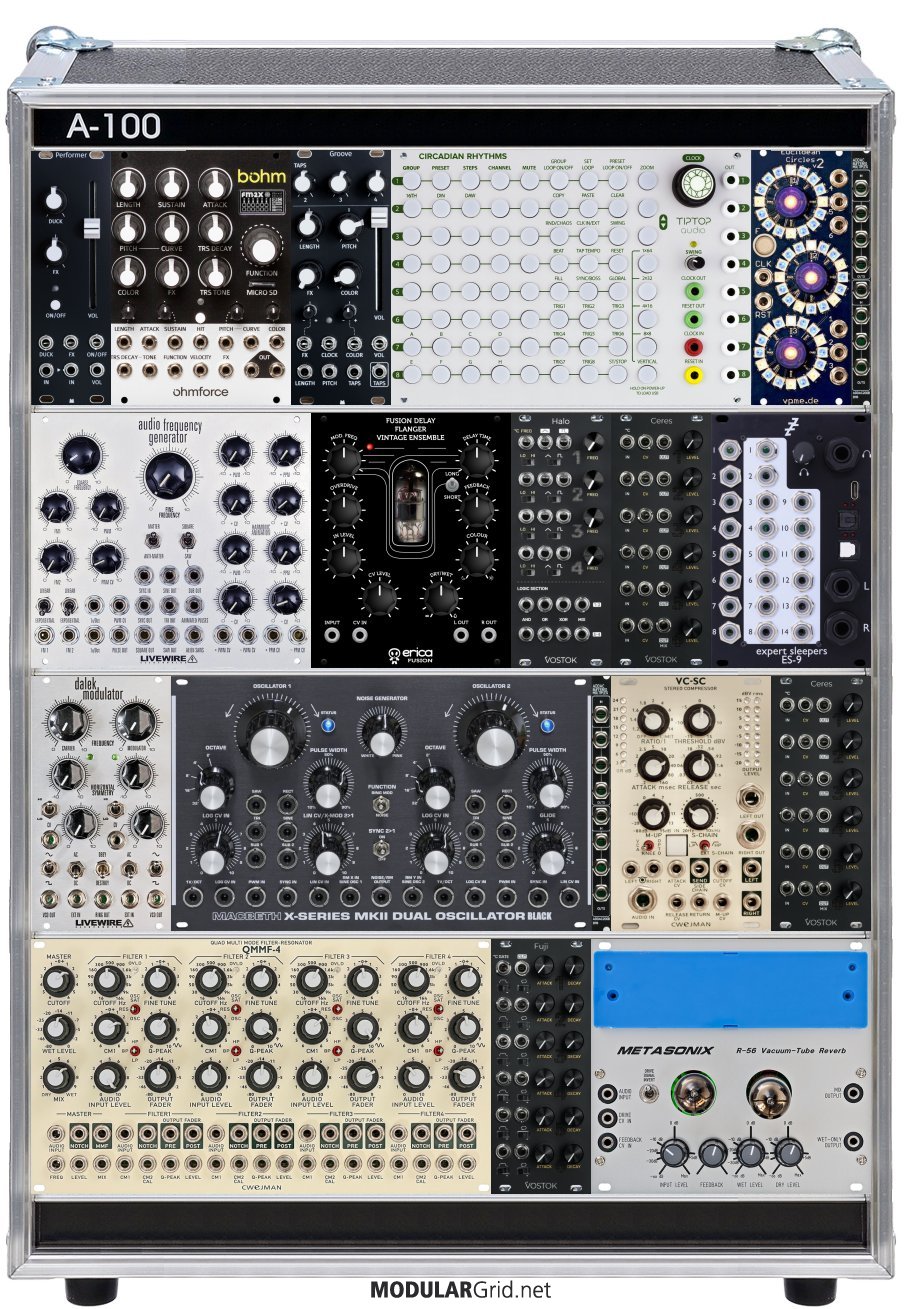
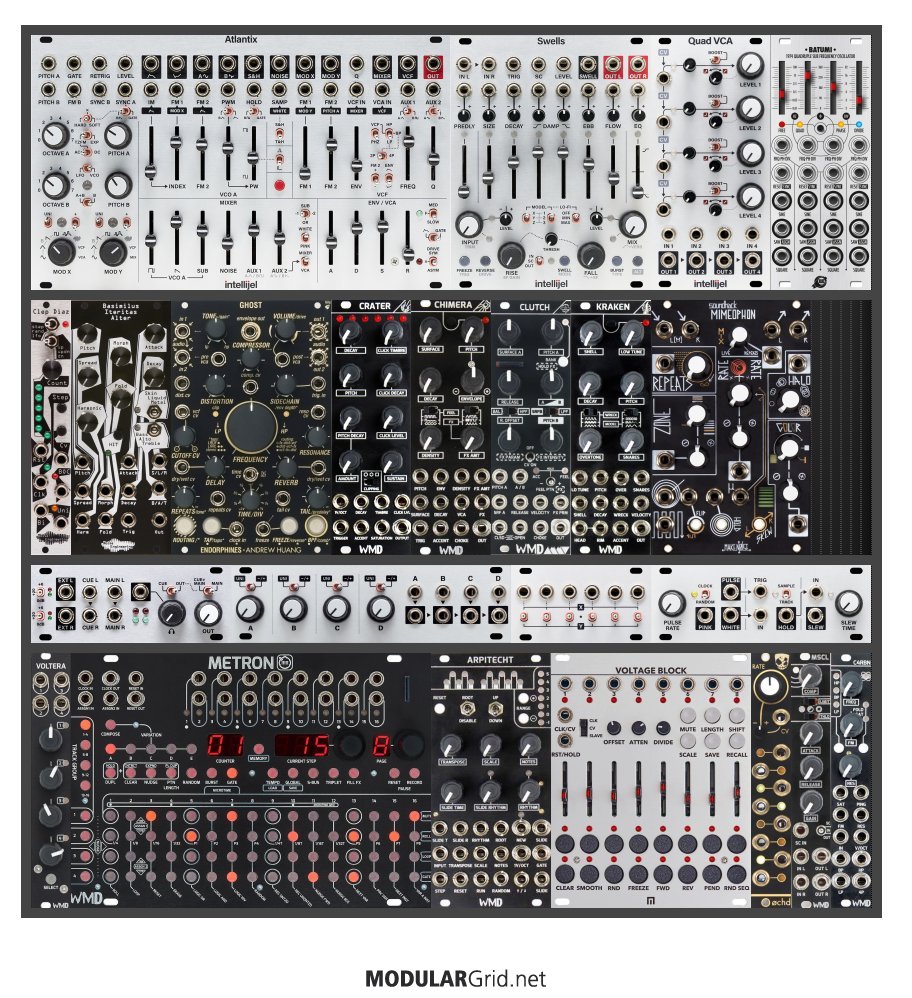
If you put your rack on public and post the link, it will appear on the forum as an interactive rack.

For a rack like this, it is common to add something like Mutable Instruments Ears or Mikrophonie right at the front. It boosts the signal to Eurorack levels. It's essentially your output module, but in reverse. Things like filters and distortions react differently to different gain levels. Both of these are not in stereo though.

Alternatively, VCAs with extra gain (i.g. Mutable Instruments Veils) can also boost the signal to the right level for both L and R signals. The advantage of the first method is that you also get a gate, envelope follower and a piezo microphone. The envelope follower will work nicely with the Nebulae. The raw piezo noise works surprisingly well with tons of reverb and effects.

If you're not going to record with the in L & R from the Nebulae, but will only put samples on the USB stick, you can skip the above contemplations.

Behringer is obviously hideous and shite, but you don't need me to tell you that. I always mention ARC by NANO and Rampage by Befaco as affordable Maths equivalents.

I wonder if Zverb and FX Aid will play too much in the same ball park. Zverb is also mono in, while the rest of your current setup is stereo.

A mult could be good, but in your case I think two small stackable cables would suffice. You can stack on both ends, so it's essentially 1 signal into 3. It's cheaper and you don't lose the (soon to be very limited ;) ) HP space.

plaits? qu-bit chord2

I don't think Chord has an use case in your system. It will be similar to the samples you recorded in your other synths or DAW or on the Nebulae. If you record some chords on your usual synth, you have total freedom and complexity. All of the notes you play on a synth have their own timing, envelopes, individual filter movement. Chord just outputs a set of notes without all that (im)perfection. I'm not sure what your further synth setup looks like, but have you considered a Moog Mavis or Mother32 or Labyrinth as a future sound source? You have the space on the second row. Plaits, as you mention, is also a popular choice.

XAOC Zadar could be good, it has very complex envelopes/LFOs. There's many shapes, but it's a set library though, some people don't like that.

If you have a friend with a 3D printer, they could print you some blank plates, to hide that empty second row. It's a little safer and nicer to look at.


Steppy could be an option, but I don’t have a 1U row

Steppy is in both 3U and 1U. I've played with the LL8 myself, it's a great choice.


Pam’s Pro Workout is accurate enough to serve as both the master clock and drum sequencer, but I’m more drawn to the 6equencer. It’s immediate and avoids menu diving; it just lacks the clocking capabilities.

Pamela can sequence, but it doesn't have the hands-on control you'll want or even need in a live situation. Do you currently own this system? How do you feel about it?

The budget-friendly fix is to get a hardware sequencer, although the OXIs are very expensive. But just using that for drums seems like a waste, I would also remove Rene if you go this route.

If you just want drum sequencing without melody, check out these:
* Robaux LL8 2 or Robaux SWT16(+). These are tiny, no menus, no saving, cheap for Eurorack, very quick to use. Eight or sixteen drum channels.
* Doepfer A-157-1 (you need -1, -2 and -3 as a set). This is huge, no menus, no saving, you can see and directly edit all of the drum parts. Eight channels.
* vpme.de Euclidean Circles v2. Tiny, six channels, no saving, very quick to use, very musical because of the euclidean system. You don't have total freedom because it only has euclidian rhythms.
* Intellijel Steppy. This one is pretty popular, it's good and hast the most options. Internal memory. just four channels.

I also want to mention that the Bohm expanders need to be connected to the main module in the back, so the way you're spreading them now should not be possible.


The way you describe it, it seems almost like there is only one way to hook up this system. I would advise you to think fluidly about this. I often think 'what if I would patch up X to Y instead of X into Z'. Oftentimes that leads to hours of fun and exploration.

I try to maintain the limitation of the 104hp 4u case

Why? I think you'll find that a system with a bit more room will open up your module options and may even be less expensive in that way. You'll also have a better user experience if you can really get in there. If case price is a problem, you may consider building your own case. It's not that hard. Or maybe you have a friend who can work with wood or laser cutters or 3D printers who can help you make one.

A non-Eurorack sequencer can also help you here like Beatstep Pro, Korg SQ64 or Oxi. I'm assuming two Steppy and Melodi would be about 450 € used, you can get a Beatstep Pro for 135 € used and then you have one extra melodic channel more and some 60 HP (1U+3U) room in your case.

but find that I have roughly 15 mins of playability. After that it feels like I am repeating myself

It seems like a bit of a waste to me to have so many modules double and it does not surprise me that repetition is around the corner. Two Steppy, two C4rbon, two SYO.5, two Pip filter, two Peaks. No two modules, even if they serve the same purpose, are alike and can give you different ideas or ways of working and interacting.

In general
* LFOs keep things fresh, one is extremely limited for the amount of modules you have. Eowave Zone B.F. is pretty thin. Xaoc Batumi is a popular choice.
* Some DJ crossfader 1U could be cool instead of the switch.

Have you considered
* Remove one Steppy -> Doepfer clock divider / VPME - Euclidean Circles / Non-Eurorack sequencer
* Remove one (or two) SYO.5 -> VPME Quad Drum Voice / Endorphin.es Two of Cups / Noise Engineering Basimilus / Try out all Tymp firmwares and maybe find something different you like there
* two C4rbon, two SYO.5, two Pip filter, two Peaks -> Surely there's other interesting filters and VCOs out there.


should keep atlantix and i kick out dixie and buy another vco?

I think the Atlantix will be great for your system because it has a lot of possibilities that you otherwise don't have:

  • Through-zero FM with set ratios
  • Bandpass
  • ADSR
  • Sample and hold
  • Noise

Never underestimate simple noise. It makes your filters sound gritty, introduced instabilities, and noise+a/d envelope+vca=rudimentary hihat. Sample and hold introduces stepped random anywhere in the system. I would say that both are necessary building blocks, useful in any system.

Shapeshifter is a really good sound source and would suit techno and ambient patches.

another VCO or shapshifter, should i buy with it a separet filter and adsr

I feel that you need at least one filter per VCO. Often the filter adds more flavour to the sound than even the oscillator itself. Even in your current setup, I would prefer one more filter. You may want to filter an effect, the Basimilus, etc. I have two VCO in my own system and four filters.

An ADSR is great if you will be playing on a keyboard. If you are only using the sequencer, Maths can make an ASR. You have enough envelopes with the four AD from Quart and the two AD/ASR from Maths.

So without the Atlantix I would go for : VCO, 2 filters, ADSR only if keyboard, some kind of noise/S&H source like Noise Tools 1U Intellijel.


Seems fine to me. I guess only you can decide if you are missing sounds. (dedicated) Hihats maybe for techno?

Or I guess Dixie is very similar in sounds to the Atlantix. Maybe a different flavour of sound source will be good. ALM Cizzle, Intellijel Shapeshifter, Erica Black Wavetable VCO, many others are available. Anything wavetable, FM, digital, samples(?) gives you more sounds to play with.


Hoi,

First of all, as I mentioned, I understand why you'd not want to do it the complicated way. I'm treating it like an experiment to see if I can learn what a module does.

Here's what I used

1 a bipolar mixer for the subtraction Triplatt
2 a DC coupled ringmodulator. Boundary
3 a shift register. Maybe I'm wrong here, but I added an offset and treated that as zero point.
4 a CV controled slew limiter. Boundary


I was able to do it today with a second module to manipulate the rise time based on pitch. But I understand now why you'd want a module for this. Thanks for sharing.


I'm sure that these modules will be really really amazing, but it's a bit like buying a Lamborghini car for your weekly grocery run. If you have the funds to get something like this, go for it! But please be aware that even for recording or playing live, you don't need this level.

The Orthogonal Devices ER-101 + ER-102 sequencer has four channels, that's not that many in a techno setting. Think kick, hihat, closed hihat, maybe a clap or other percussion, one or more voices, some control over a reverb wash or delay, you can easily fill eight channels. You could look into Erica Synths Black Sequencer instead of Orthogonal Devices ER-101 + ER-102, that's four channel with MIDI IN for four note polyphony, but for techno you'd need to combine that with a trigger sequencer like Doepfer A-157-1. You can take CLOCK OUT from the Black straight into the Doepfer. That last one is really nice because you can see all the moving channels in real time. Robaux LL8 2 is much smaller and cheaper and does the same job.

I see you made some great changes to the rack on Modular Grid. From here I'd maybe reconsider the QMMF-4 due to its size, and get something like Erica Synths Graphic Resonant Filterbank or Schlappi Engineering Angle Grinder or 100 Grit or another of many many interesting filters so you have some open space for things you may feel you need after playing with the system for a while.


Hi, I'm not sure what a 303 specific slew limiter would be like, but for slew limitation I use and like the Schlappi Engineering Boundary. Maths can also do it.

On the Boundary you would go v/oct into SLEW and then send a trigger to RISE on notes you want to slide to lengthen the attack phase.


That's quite the budget you have, you are moving straight from beginner to extremely advanced.

I see you're spending 28 HP on just a reverb, you're probably going to need a much bigger case.

If you're making techno, where's the techno stuff? You can go two routes here, either get some modules that do one job, or use the modules you have selected now. I would go route one, because I would not sacrifice one of two channels of that big oscillator just to get a static kick.

For route one
- A dedicated kick. For your budget you'll probably want the full Bohm set (Bohm, Bohm performer, Bohm groove).
- Highhats
- Just two envelopes from Maths will not get those five oscillators running, I would add at least four more but maybe six or eight so you can play the oscillators and move the filter independently. Maybe Intellijel Quadrax?
- Just four VCA is not enough to get five oscillators running, I would add four more.
- Sidechaining (can be done with that Bohm set)
- A delay
- A distortion or maybe two (Schlappi Engineering 100 Grit)
- More LFO to keep it fresh and not result in static sounds
- You are missing one sequencer for those oscillators

also want to be able to patch polyphonic sounds occasionally

Your sequencer of choice does not have MIDI IN. How will you play the polyphony? You'd need some keyboard with four v/oct on the same channel.


If you post the link to the rack, people can click it and see the modules.

ModularGrid Rack


Thread: New rack

I personally would go for this one:

Intellijel Quadrat
https://modulargrid.net/e/intellijel-quadratt-1u

None of your VCOs are stereo, so you don't need the stereo submixing, and the Quadrat can mix CV as well as audio.

If you find you don't have enough mixing, you can still add another mixer later.

1u buff mult - yeah go for it. I see no advantage in the Add 2.

Swells and Batumi are both good choices.

Further down the line, some envelope(s) would be good, so you can get some filter movement or effect to move with the sound.


Thread: New rack

I find making suggestions for this one a bit difficult. All your voices are pretty much standalone, with the envelopes and filters on the modules themselves. So you don't really need anything in that aspect.

I think that if I were to add anything to make this rack more complete, some extra envelopes/LFO or utilities would be the first thing on my mind.

I agree with the Intellijel quad VCA you mention.

Intellijel Triplatt - three channel mixer and attenuator. You can use it to combine your drum section and feed it into filter or effects. It will also help you shape your modulation by attenuating LFOs or envelopes. Without something like this, it is difficult to keep the LFOs from modulating things too hard. The Quad VCA can do something similar. Or Happy Nerding 3x MIA. Or even something super simple like Doepfer A-183-5.

Xaoc Devices Zadar or Batumi - The first one has a screen and four envelopes or LFOs that you pick from a list. Best enjoyed on a bit slower music. The second one has four traditional style LFO. Either one of these will create movement in your sounds.
Alternatively Make Noise Maths, Befaco Rampage all give two snappy envelopes with extra complexities.

A mult.

These will help you achieve the most with the modules you have already bought. Other than that, I suggest you to hook it up and play with it and see what you would want more of.


Thread: New rack

I will do it for you:

ModularGrid Rack


Thread: New rack

If you post a link to the rack on Modular Grid it will be easier to see what all the modules do.


generative melodies

  • Qu-Bit Bloom - soft sweet kind evolving melodies
  • Some sort of rungler - more random, a bit more aggressive usually, you can lock it in.
  • A random source and a quantiser.

Polyphonic chords

Because of the nature of eurorack it doesn't handle polyphony well.

For example I have the Mutable Instrument Yarns, that I can use to control four voices polyphonically. But then I need four voices, four filters, four envelopes and four VCA. Quite a big and expensive case. And every time I want to change a sound I have to change all of those options. That doesn't allow for very immediate live playing because I don't have enough hands to change four filters at once. There's ways around it, with more modules that would send the same CV to multiple modules. But what do you really gain here that is not better in polyphonic instruments.

If you just want chords to play from one 1v/oct, there's a couple of options like a sample player with chords in it, or I also like the Intellijel Shapeshifter which is a double wavetable oscillator with a chord mode. Keep in mind that you'll usually only be playing one chord variation (Cm, Dm, Em, etc) which usually sounds a bit primitive and not unlike early gabber. I also find that these are never as full or lush as real chords played with multiple oscillators or a regular instrument.

Ambient drone backdrops + Sonic exploration
- Befaco Oneiroi is very hands-on and playable, great for big washes or screeches from hell itself.

What didn't make it: ADSR envelopes

You'll really want at least ASR when working with a keyboard so that it keeps playing when you hold down the key. I really prefer an ADSR where you can set the sustain level for keyboard playing.

I didn't touch on everything you asked, but I hope this will give you some new insights!

EDIT: One more tip about hands-on playability. If you can get your drums out of Ableton through an OUT on your audio interface and into an Eurorack filter, that already gives a lot of sculpting options and live playability for build-ups and breakdowns etc.

EDIT2: You can see the waves in Ableton using an oscilloscope. I use this one https://maxforlive.com/library/device/1918/jo-floating-oscilloscope . There's also a tuner in Ableton. DATA feels a bit useless to me, but maybe you have better uses for it then just looking at waves.


Check out Takaab/Siam Modular, I have very good experiences with their utilites and they're really cheap.

It shouldn't be like this. Synth can be affordable
-- bartlmju

If affordable is the main point, why punish yourself with Eurorack and not get a Korg Minilogue XD or an Arturia Minifreak? Put some drum loops on your DAW and you'll be churning out bangers in no time.


I like the Make Noise Echophon the most. The other -phons are a bit too left-field for me. I don't like it when Make Noise makes the controls weird and unintuitive. The Echophon can, apart from echo, also totally change the tonality of the sound, or work as reverb, chorus, etc. It's very dreamy with it's pitch-shifting capabilities.

Make Noise Bruxa has an awesome sound with delay+filter and heavy/distorted resonance. Sounds great in specific cases but maybe slightly a one-trick-pony, meant for grand movements, not for light end-of-chain effects.

Befaco Oneiroi is great too for big cavernous sounds.

I'm currently using the Qu-bit Stardust, you can dial in a very precise delay using the Frippertronics mode and all of the other effects (tape distortion, bit reduction, flutter and wow, low and high pass, reverb). You can choose to apply the effects on the delay or loop, or also on the incoming signals. It works as a v/oct sample player or looper. But my gripe with it is that it's a jack of all trades, master of none. For example it's very difficult to properly sync as a percussive looper. You basically have to set your global bpm to the bpm of the drum loop sample, rather than the other way around. I also feel that it's too expensive for what it is.

My favourite effects are actually the Alpha Omnicron bass distortion pedal and the EHX Oceans 12 pedal that I have in a FX chain with my audio interface.

Hope that gives you some inspiration!


It makes the Doepfer look quite premium.


Thread: My rack.

I would much prefer the Intellijel µVCF, as

  • Doepfer does not promise v /oct tracking.
  • The lowest Hz on the Intellijel is 2 Hz, meaning it cycles twice per second. That's fast for an LFO but still useable. 10 Hz on the Doepfer is steadily leaving LFO terrain.
  • Intellijel has attenuators for both FM inputs to create complex modulations or complex FM tones together with the Atlantix (bells, rudimentary DX7 epianos etc)

A resonant filter with a pitch decay envelope into FM and an amplitude envelope after the Filter Out is a great simple percussion sound. On deep cut-off it's a kick, half-way with some noise in the other FM it's a snare, and pitched very high with noise it's hi hats.

Here's a video on how to get some other shapes out of it


Thread: My rack.

Hi ambientvalent,

If you post the link to the rack and not have it on private, it will show up on the forum as an image and interactive, so that we can see the module descriptions.

For simple attenuators you can use the Mixup and Amps modules that you currently have.

I think that if I owned this and wanted to make ambient, I would either add a second oscillator with a different flavour, or a second filter. You have a lot of nice utilities that have more 'modulation outs' available than you need for just the Atlantix. Most (self-oscillating) filters and oscillators can be slowed down far enough to work as LFOs as well.

Atlantix has two oscillators, a second oscillator module could complete a 3-voice chord. Or use it on it's own when you don't feel like Atlantix for a day. For different flavour oscillators you may think about:
- ALM MCO2, it has digital libraries like wavetable and physical modeling and a built-in filter and envelope and is only 6 HP. Most of its controls are in menus though.
- Famous Plaits in a 6HP clone version, has digital libraries and a low-pass gate. No real filter and there's only one filter in your system so far.

A second filter can be used on the second oscillator of the Atlantix, or use the Atlantix filter and the second filter in series or parallel. I would either choose something that can also track 1v/oct and self-oscillate so that you can use it as an oscillator+lfo, or maybe an Oberheim style state variable filter (which will traditionally not self-oscillate) as it can move between filter types fluidly, great for ambient.

If you stick to 6 HP, you can use that last 2 HP to get an extra utility of your choice in.

Hope that helps, good luck!


Hi Horpsnark,

I'm not familiar with all of these modules, but it seems to me there are no envelopes or (dedicated) LFO or VCAs or mixers in this system. In this case the Pico VCO will just sound like a continuous drone. There will also be no automated/continuous modulation in your filters or any other modules. Everything will be quite static.

How will you sequence notes or triggers? Do you have some external sequencer? I guess Marbles will sequence, but not in a really controlled way.

How will you output all of these instruments to make sound? Do you have an external mixer?

You have three instances of Drum2 in your system. Unless you really really like the Drum2, it's probably more fun and more creatively challenging to have different modules.

I like the Black Dual VCF personally, but it's quite huge. In such a small system as yours, I would probably pick another filter so you can use that space for other modules.

If I was making this, my first step from this point would be to have some external sequencer. I like the Beatstep Pro, it has two lanes of melody, velocity (can be used for other modulation) and gates. There's also 8 individual drum gates. You may need to get some extra cables to deal with the high voltage coming from the Beatstep gates. Then I would add something like NANO Quart or Intellijel Quadra or Mutable Instruments Stages (clone) to have some envelopes to work with. Envelopes can also be LFOs when put to loop.

Good luck!


If you know it's too cramped, why not get a bigger case? Branded cases are expensive, but have you thought about making your own? You don't need much knowledge about electronics to do this. You can find information on this online. A friend of mine has his eurorack in a second-hand metal briefcase. I have mine in a wooden case. The person at the hardware store cut the wood for me on the band saw and the only thing I had to do is put some nails in it and drill a hole for the power cord. That would open up your possible module choices tremendously, and give you a better user experience in the resulting system.

I also want to mention that Make Noise enjoys a legendary status but from a 'costs vs quality' or 'costs vs functions' perspective I'm not impressed with their modules.
Maths alternatives for half the price/A bit weird envelope generators: Befaco Rampage, Nano Arc, Cre8audio Function Junction.
I think you will really enjoy Schlappi Engineering Boundary Layer, it's slightly more expensive than Maths but has three channels and all kinds of logic functionalities, it also works as a chaotic oscillator and the envelopes are super tight.
Low Pass Filter alternatives: Takaab 2LPG, Erica Synths LPG, DUAL BORG. I recently used the DUAL BORG for the first time. It's a dual low, band and high pass KORG MS-20 with two built-in LPGs. Pretty good feature set.

You're running a mostly mono path right up to the MN X-pan and Beface Out. To take full advantage, either add more stereo stuff earlier in the path (stereo filter, stereo effects module) or swap out these modules for a quad VCA mixer or something like this. Depending on your setup, you can go straight out the VCAs without needing an extra output module.

Good luck, have fun.


I remember an interview with James Blake (I think it was on Mylarmelodies exceptional "Why We Bleep" podcast), where he talked about Mutable Instruments Yarns for some tempo detection via Midi
-- Progspiration

I was interested in this because I have MI Yarns and I watched this interview. It's indeed Why We Beep with James Blake and at time 1: 06 :00 they discuss the Yarns.

I paid 170 € including shipping for a second-hand Yarns last year and there's better deals here on Modular Grid at the moment.


Great, I hope you have fun in your journey!


I would humbly like to point out that there is nothing odd about using a low pass gate with a complex oscillator. This is literally one of the main building blocks of west coast style synthesis.
-- Zacksname

You're absolutely right with the historical connection. From the point of view of building a monosynth I still think a more 'normal'/east coast filter would be really good. Maybe get both! There's many small cheap LPGs available. My friend recently bought a Takaab 2LPG for just 20 €, it's tiny and sounds great. It has three responses/flavours. I have the Meng Qi DPLPG and it's also good but there's just one flavour. I paid about € 50 for it. Both are passive.


Based on your information the NiftyKeyz will send multiple melodies so you are sorted on that point, even without the mult. So either passive or buffered will work in your case. It also depends on whether you have enough power spots in the case to power all modules including the mult.

I don't think the decay out envelope on the LPG will be all that useful, since it's decay only, not even Attack/Decay. You probably want more complex movement in the filter and also outside it than just decay.

I think I would remove either the Frap Tools 321 or the Erica Synths Black CV Tools, they are kind of in the same ball park. And then use that space for another envelope. If you plan to play the keys a lot rather than just sequencing, you may want to add an ADSR for perfect control. You can then double it to the filter or use another envelope.

For filters, Erica Synths Black Multimode Filter, ThreeTom Modular Steve's MS-22, Tiptop Audio Forbidden Planet or System80 860 (MK1/MK2) are all good choices with the same or lower HP as the LPG at a somewhat similar (secondhand) price. They all have very different flavours.


There's two things that catch my attention here. Other than that, it seems well-rounded. The most-often made mistake with eurorack beginners is a disbalance between audio sources and audio manipulators. You did well on that part.

What I am mostly wondering about is your filter options. You have a LPG (low pass gate) rather than a LPF (low pass filter), a bit of an odd choice. There's videos on Youtube explaining both principles. A module that can do low pass, high pass and band pass filtering will give you more options to play with. But maybe you picked this one on purpose, I'm not familiar with the module and it seems like it can also do normal filtering. Something to think about. If Plaits and Mindphaser are ought to be processed individually, you probably want two filters.

If you really like spring reverb, then go for it. I would not find a great match between Mindphaser and a spring reverb. There's many (cheap or expensive) reverb pedal choices with more flavours of reverb than just springs. I have the Oceans 12 pedal which is the same price as a new assembled Befaco Spring Reverb. Maybe it's overkill for you. EHX Oceans 11 and TC Hall of Fame are cheaper but great options. If you want to keep it in eurorack, the multi-effect unit FX Aid is a popular choice and will give you much more than just reverberation.

One last thing, a passive mult will not copy v/oct melodies. The passiveness will cause a detune to the melody. So you can't mult it to both Mindphaser and Plaits. Maybe there's a solution on the NiftyKeyz, I have no experience with it.


I have a Eurorack. Every module I have bought second-hand. If there's ever any problem with a module, it's the mini pods that become scratchy and noisy. This AE Modular is mini pods start to end. I would worry.

Have you thought about …

If you want a large rack:
-VCV rack is free or cheap software, it can't break and doesn't break the bank

If you want hardware:
- Korg MS-20 Mini is very doom-like and you can still play with cables and signal paths and it will last a long time
- Korg Volca Modular is cheap and you can still play with cables and signal paths
- A small number of second-hand eurorack modules from fairly affordable brands like Doepfer, Erica Synths, Rides In The Storm, Dreadbox coloured modules


Thanks for pointing out the overabundance of mixers, thats because i never worked with stereo audio signals and since i would like to process and mix in the final output both the oscillators and the processed external audio at the same time i thought a certain amount of stereo mixer channels were required, but i inserted too many.

Okay, but let's say you have something awesome going on and you want to record this to make a track with it. Probably you're going to want to make the final sequencing and build-ups and touches in your DAW anyway, so why not first record your first voice and then your second voice and mix them together when you're making the track in your DAW. For jamming you can put all you sounds through a single stereo out and when it's time to get serious you record the voices separate. Then you only need one stereo pair out and you don't need to constantly use four inputs on your Audio Interface. Makes it also easier to jam with friends on a small mixer. It's up to you of course what you find important and how you spend your cash.

it has individual amplitude controls for every mono channel so maybe that could bring some light imbalance between the Right and Left signal of a stereo sound, does it makes sense to you? Thats another thing im not entirely sure of).

Don't worry about that, you can see it super accurately in your DAW and fix it there :). Maybe it even sounds better with imbalance. I have the Intellijel Triplatt myself and it's great for submixing and fixing/attenuating modulation stuff so I'm sure you will enjoy the Quadratt.

Still i don't understand how a mult could get a double L+R input into one output, i thought they are just replicating the signal inserted in the first patch point: are you saying they can mix 2 signals in a single output like in a mixer?

I just checked it on my eurorack because I confused myself a bit. If I have a 3 mult and I put in 2 oscillators and put the third socket in the Audio Interface then I hear both oscillators. The mult doesn't have real ins and outs. What you put in sockets comes out the other sockets. But here's the thing: in a melody and already enveloped situation I got the sound perfectly. But when I just take the full non-modulated oscillator sounds on the same octave in the mult there's this weird-but-cool noise-cancelation effect going on. So yeah, to be safe submix on the Quadratt and I think most of what you said will be fixed in the module when it outputs both channels to Left (mono). But you can definitely use the mult to put two modulation sources in and use them together at one destination and in a pinch the mult will also work as a equal gain mixer. I have a small eurorack and I like the noisy parts so for me I don't worry and it's 'sound design'.


Hi, I will try to answer your question as well as give some advice.

mono/stereo issue: most modules that have stereo outputs will go into mono if you only use one exit. Often the left output. Check the manuals how that works for the individual modules. So you can likely patch Monsoon Left into Grainity. and have all of the sound that was coming from the left and right input. Regardless of how you do it, after the mono Grainity the information will be mono. Running stereo into mono will always result in a mono (=both speakers the same) sound. The cable that you show has a stereo end, your mono modules will probably get no sound from that. I accidently bought some stereo big jack cables in the past and it often causes problems with Moog gear, with my bass guitar, with my effects etc. I'm sure it will be the same with 35 mm jacks.

I see you have three mults. I think you can probably suffice with two and I would also spread them through the system instead of keeping them in a corner for maximum effectiveness. The mults could get your double outputs into one input if the left mono implementation mentioned above is not in the module.

If you want a versatile and cheap LFO, the Eowave Zone B.F. Black Edition is now on Modular Grid for 46 €. That's half what I paid secondhand and frankly a great deal. Run a LFO at audio rate speed in any oscillator or VCA and you'll get interesting timbres. Please note that I'm not the seller and not responsible for the sell.

You have quite a bit of mixing modules at the end there. Mixers are sometimes optional. There is no problem going straight out from a VCA into your DAW/Audio interface if you keep the levels alright. Turning on 'pad' on your audio interface will keep the signal from overdriving. So maybe you can take one of those mixers out. Keep in mind that a Quad VCA is often also already a mixer, there is no rule on what the spot is where you take sounds in and out of your eurorack system. More VCAs is probably better than more mixers.

If you're planning on using the eurorack with the DAW always, then those two multi-effects modules might be a bit unnecessary and boring. You can apply simple end-of-chain effects in the DAW. I think it would be more fun to focus on eurorack effects with lots of modulation options, that would take advantage of the eurorack 'way of working' better.

Good luck!


You mention that you don't want volume adjustment, but I think you actually need it to get the octatrack on the same level as your modular sounds. For example, if you would use the Octatrack sound as a modulation source without boosting, you would only get a fraction of modulation out of it. Every +3dB is double the volume, so +18dB is a lot.

The one Farkas mentions has much more ins and outs, and I think that's what you want. But here's the one I have: Mutable Instruments Ears, and I like that one. There is only one 'in' on it, but it has an Envelope Follower and pretty heavy extra gain if you want it, the overdrive is very tasty. So the mangling can already start at the input module. And of course you can still use that overdrive when you don't use external gear.


What makes you say that you are not happy with the current arrangement?

Your post made me laugh a bit, because I also was trying to have all the bottom jacks top row and top jacks bottom row. And I think I also spot another sin that I am guilty of: trying to keep all the modules in black and aluminium separated.

My tip would be to try to not care about the colours and the jack positions because you will always find some other module that does not fit your curated layout.

I now try to follow the usual signal path. In your case I would have Pamela Workout all the way on the left and work my way through oscillators, envelopes, LFO, Mult, filters, VCA, effects. That's ususally how it would be on a normal keyboard synthesizer like Juno etc.

If you're scared about the cables being in the way of your controls, I find that if you layout in a way that your favourite playable knobs (for me: filter cut off) are always ready and able you will be fine with it.


I feel like people are sleeping on the MI Yarns. I bought it at the start of the year for 170 € (including shipping) and apart from being a 4-channel MIDI converter, it also works as a 4-channel stand-alone sequencer, digital oscillator, euclidiean sequencer and/or modulator. Maybe I'm missing something, but it should blow the µMIDI out of the water, giving you - apart from the midi channel you already have - 3 additional channels of notes, movements and gates.

More generally, modulators are always great. Think of MN Maths, Nano Arc, Befaco Rampage, Schlappi Boundary (Layer). Many others of course, these are some favourites.


Looks pretty good. I just want to mention these two things in favour of affordability:
There are cheaper and just as good (or better?) options for Maths. Like Nano Arc ( https://modulargrid.net/e/nano-modules-arc ) and others.
Mutable Instruments modules have been cloned many times by different producers. Opting for clones can save you a lot of money.


Here's an practical idea, building on what teatine and HGsynth said.

Rather than getting the Erica Synths Bass Drum or Bassline, you can get any 'normal' VCO by Erica Synths, combine it with a envelope generator / modulator (NANO ARC, Make Noise Maths, others), an acid filter and a VCA to get the same result, but in this case you can also wire everything differently and get things you didn't think of when you were shopping for a bass drum. That's the area that Eurorack shines in, and it's difficult to do this with regular synths.


Thread: First Rack

I agree with Max that the Doepfer A1116 is probably 'more of the same' for you and therefore not that useful. There's other types of voices out there like wavetable vcos that you may enjoy for techno. But maybe you have enough voices already, in techno there's usually a limited amount of voices, and a lot of space that is filled up with effects like delays.

You mention you want to travel with this system. Eurorack can be bulky, heavy, break easily. You will have to plug and unplug everything between rides. If travel is important to you, maybe other types of synthesizers are more interesting to you. For example, Elektron devices can do much more in a much smaller space and no cables as well. I doubt you'll be happily euroracking on a train with this system on your lap.


Nice that you managed to make a choice! Sure, would love to see what you eventually end up with and how you like it.

ModularGrid Rack

I just put my own rack to public. Maybe there's some inspiration for you to be found there. The goal of my rack is to make a big noisy ruckus, with fat analog bass and lots of knobs (hands-on control) to turn. I have it connected to an Arturia Minifreak and Ableton on the computer to get in additional sounds and sequencing.

I like all of the modules I bought. The Cellz is the only one that is not amazing but it's still fine because it's very cheap secondhand.


Hmm, it's difficult to make an oscillator choice for you. It's really personal. I think you should listen to as much material as is available for the Dixie, Sto and Buchla and choose based on that. I feel like the Sto is the 'weakest' choice here, it has the least amount of options and the least amount of knobs to turn, for the same price as the other two. But if you really like the sound of the Sto, then go for it.

The Wasp is cool and has a unique sound. It's a good choice. If stereo image is important to you, a stereo filter is a good choice. The modules you have selected now are not very focused on stereo. But if that's the way you want to move in the future it can help to go stereo on the filter. Even with a mono filter you can stack the oscillators in the mixer or the Quad VCA to filter more than one sound source at the same time.

For me, the module (it's a filter) that made me go 'wow, now I want a modular system' is the Schlappi Engineering Angle Grinder. In default settings it's a sweet sounding filter with low pass, high pass, band pass and notch, but once you start turning knobs, it will rip your ears off. For me, that is the sound I am looking for. I'm not sure if it's the module for you, but give it a listen on YouTube.


Hi, I'm quite new to this myself, but I think I can help you along a bit.

I see four oscillators (counting the Buchla as two), but not a single filter. Filters are very important for shaping your sound. Some say that filters are more important to your sound then an oscillator. There's some truth in this.

You mention you also have the Dark Energy and the O coast. That's six oscillators I guess. You don't have the amount of envelopes to have all of this stuff running at the same time.

A lot of power of modular synths comes from the ... modulations. I think you would benefit from a LFO. I was also thinking you need an attenuator, but I think Quad VCA with Maths has you covered there.

The Quad VCA will already mix four signals to the OUT 4. Will you need that Pico mixer in addition to this?

How will you sequence all of these oscillators? Maybe you have some outside device for this. If not, a sequencer or a midi to CV input will help you, depending on your outside setup.

Maybe you really want it, but I would think the ZeroScope is not that important in this small setup. You can hear the sound with your ears right? Do you need to see the waves? I see you can use it to tune, but you can tune on the computer or on your mobile phone with a free app. A scope is more of a luxury thing, for when you have so many modules that you can't remember how they work.

One last thing to think about, maybe it's even the most important thing. You mention you want West Coast and Experimental. Do you think you will achieve it with this setup? Is it maybe not too 'normal'? If you want something very specific, you should lean into this specific thing. If you're crazy about Buchla, get the Buchla oscillator and drop the Sto and Dixie (for now). Any full, non-modular, synth can go beep beep boop. You don't need an expensive modular system just to go beep beep boop.

I hope this helps you. Maybe you think I'm being too rude, but I'm just inviting you to do some critical thinking.